Misrepresentation Found by Federal Court Despite Claim by Applicant That Visiting Agent Had Entered Wrong Information
Musembi v. Canada (Citizenship and Immigration), 2026 FC 1241
The Federal Court has denied a judicial review application where the refusal of permanent residency was made under subsection 40(1)(a) of the Immigration and Refugee Protection Act (IRPA). The matter raises an important point in Canadian immigration cases: Can an immigrant avoid misrepresentation if he claims the visiting agent entered the wrong information without his knowledge?
In Musembi v. Canada, the Court held that the immigration officer reasonably dismissed that claim.
What Occurred in This Case?
The appellant was a Kenyan citizen who had previously applied for a Canadian Temporary Resident Visa (TRV). When applying for a Canadian Temporary Resident Visa (TRV) in 2021, the details provided to Canadian Immigration officials revealed that he had been married since 2018 to a lady named Joan Nderitu.
However, when he applied for permanent residency in 2023 under the Spouse or Common-Law Partner in Canada class, the appellant claimed he had never been married. This became a material issue because the applicant married again in Canada in July 2023 and then proceeded with that relationship for his permanent residence application.
The Applicant Stated That the Visa Agency Had Added the Incorrect Information
IRCC informed the applicant about the problem by sending a procedural fairness letter.
The applicant indicated that an agency had helped him apply for a TRV visa previously and had added information about the previous marriage without his consent or knowledge to increase his chances of getting a visa.
The applicant stated that he had neither met nor married that woman mentioned in his TRV visa application. The immigration official was not convinced and denied the permanent residency application on the ground of misrepresentation.
Misrepresentation Under Canadian Immigration Law
Clause 40(1)(a) of the IRPA renders a foreign national or permanent resident inadmissible if they provide false or misleading information, either directly or indirectly, regarding a material matter that has resulted in, or may result in, an error in the administration of Canada’s immigration law.
In addition, the Federal Court noted that misrepresentation is not equivalent to a situation where the applicant made a statement with the intention of deceiving the immigration authorities. The Act also considers indirect misrepresentation.
What is the 'Innocent Misrepresentation' Exception?
The applicant's first argument was that the erroneous information falls under the small exception called innocent misrepresentation. The Court clarified that the exception applies in rare cases. Normally, the applicant must believe in good faith and reasonably that no material information is being misrepresented, and that the incorrect information lies beyond the applicant's control and is unknown to them.
In the case before the Court, the immigration officer considered the applicant's argument above.

Blame the Immigration Agent for Errors?
This is among the most critical factors in the case at hand. The Court held that the immigration officer had a basis to conclude that the applicant cannot shift all responsibility to the agency alleged to have prepared the TRV application.
The officer observed that the previous application did not state anything about any individual's representation. The key factor is that the Court accepted the general principle that the applicant is responsible for reviewing the information in the immigration application in his/her name.
Even assuming the agent entered the information without the applicant's consent, the Court stated that the immigration officer had a basis to conclude that the applicant was responsible for ensuring the application was correct before submission. This makes the case relevant to applicants who use immigration consultants, travel agencies, representatives, etc., to prepare their Canadian immigration applications.
Was the Applicant Granted Procedural Fairness?
Further, the applicant claimed the procedure was unfair.
One reason he stated is that the immigration officer should have followed up with him to obtain verification from the authorities in Kenya about his marital status. The Court dismissed this claim. The Court stated that the applicant bears the burden of presenting the necessary evidence to support their claim.
Were 14 Days Sufficient Time to Reply to the Procedural Fairness Letter?
The respondent further claimed that he deserved 30 days for his reply to IRCC's procedural fairness letter rather than 14 days. The Court disagreed.
Nothing on record could be deemed a clear representation or practice that would create a legitimate expectation of 30 days. In fact, the procedural fairness letter clearly indicated 14 days for the respondent, and he even replied after three days. The Court further ruled that the shorter time period did not deprive him of his right to reply.
How About the Applicant’s Previous Entry to Canada?
The applicant also referred to an earlier instance in which he came into contact with a Canada Border Services Agency officer at the port of entry into Canada. As far as the applicant was concerned, a border officer had interrogated him concerning the existence of his alleged previous wife when he arrived in Canada but permitted him entry to the country.
However, the Federal Court dismissed this argument as well, since no evidence showed that the earlier officer had determined misrepresentation at the port of entry, even if the officer had accepted the applicant’s explanation.
What Was the Federal Court's Decision?
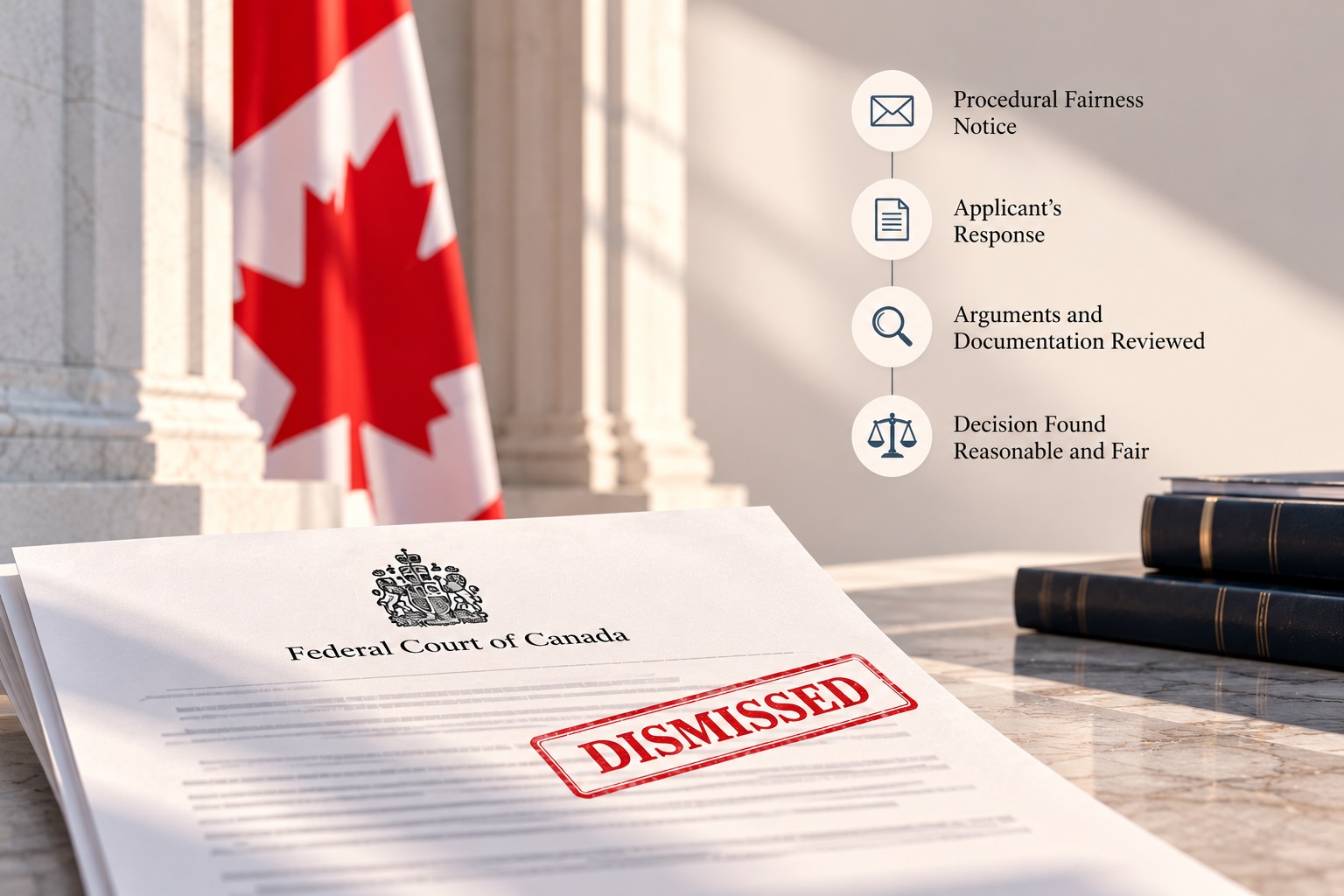
In its decision, the Court concluded that the immigration officer's decision was reasonable and that the applicant received a fair process.
The applicant was notified of the specific issue through a notice of procedural fairness, was allowed to respond, and the Court considered his arguments and documentation when it made the decision. The Court dismissed the application for judicial review and did not certify any issue of general importance.
What Are the Implications for Immigration Applicants in Canada?
Musembi v. Canada indicates that a claim against the agent for erroneous information is not always sufficient to protect an applicant from misrepresentation of immigration purposes.
Applicants must be careful to check each form, statement of purpose, employment record, marital record, travel record, and other documents presented to IRCC in their name. The case shows that an "innocent misrepresentation" claim can be highly fact-specific and relatively limited. Where the mistake could have been noticed by reviewing the application, it may be difficult to rely on the exception.
Nonetheless, each case of misrepresentation is highly individual and depends on the specific facts and circumstances. The applicant's knowledge, the representative's actions, the availability of documents, delivery of the procedural fairness letter, and the officer's approach to the applicant's explanation can play an essential role in assessing the possibility of judicial review.