Application for Leave and Judicial Review in Canada – Reviewing Negative Immigration and Refugee Decisions
Just because an immigration or refugee decision is negative, it does not mean that the process is over. There are instances wherein a person can question the decision by filing an Application for Leave and Judicial Review with the Federal Court of Canada.
The process of judicial review gives the Federal Court the opportunity to determine if the decision made by the immigration official/tribunal was legally valid and procedurally correct. Judicial review covers different issues such as visa refusal, PR applications, inadmissibility, and decisions of the Refugee Protection Division and Refugee Appeal Division. It should be noted that unlike an appeal, judicial review is not a full review of the case.
What is Judicial Review in the Canadian Immigration Context?
Judicial review refers to a process where the Federal Court reviews the decisions made by administrative bodies of the federal government. According to section 72 of the Immigration and Refugee Protection Act (IRPA), an applicant will need to obtain the Court’s permission in order to go forward with the judicial review application.
The Court could consider if the decision was made:
· based on an inaccurate understanding of the evidence.
· without consideration of some key facts or arguments.
· with contradictory or insufficiently reasoned findings.
· in violation of the principle of procedural fairness.
· with wrong interpretation of the law.
Nevertheless, disagreement with the conclusions reached by the immigration officer would not necessarily qualify for judicial review.
Is It Possible to Challenge an RPD or RAD Refugee Determination?
A negative determination of the Refugee Protection Division (RPD) or the Refugee Appeal Division (RAD) could be challenged at the Federal Court, under the requirements of law.
Judicial review is possible when:
· The RAD has denied the appeal of the refugee status.
· The applicant is not eligible to appeal against an RPD determination to the RAD.
· There is a material mistake regarding credibility, evidence, country conditions, or procedural fairness on the part of the tribunal.
In the case of being eligible for appeal to the RAD, the appeal has to be exhausted first before applying for judicial review. The Federal Court does not normally decide whether the applicant has the right to refugee protection. It reviews whether the tribunal determination can be challenged judicially.
Grounds for Judicial Review
The Canadian judiciary usually follows the reasonableness standard in determining the validity of decisions rendered on immigration matters by administrative tribunals.
As articulated in Canada (Minister of Citizenship and Immigration) v. Vavilov, 2019 SCC 65, for a decision to be valid, it must be justified, transparent, and intelligible in relation to the applicable law and facts.
Grounds for judicial review include:

1. Failure to Take into Account Material Facts
The decision-maker may have made a reviewable error if he has failed to take into account or has misunderstood the material facts underlying the application.
2. Unreasonable Credibility Determination
The credibility determination in a refugee case may be questioned where such a determination is based on speculation, assumption, or unexplained contradictions.
3. Lack of or Inconsistent Rationale
Reasons for a decision may raise concerns of unreasonableness where there are important logical omissions or lack of explanation for a finding of fact on a material issue.
4. Procedural Unfairness
Concerns related to procedural fairness may include where an individual has not been given an appropriate chance to respond to certain allegations.
5. Mistakes in the Implementation of Immigration Laws
The misinterpretation of laws or the lack of compliance with certain legal obligations can be another factor to consider when applying the standard of judicial review.
When Does the Deadline for Judicial Review to the Federal Court Apply?
According to IRPA section 72(2)(b), there are two deadlines:
· Decision arising = Inside Canada, Deadline for filing = 15 days
· Decision arising = Outside Canada, Deadline for filing = 60 days
The deadline generally begins from the time that the applicant becomes informed or otherwise learns about the decision being sought.
Ordinarily, RPD and RAD decisions of the refugees fall within the 15-day deadline.
Section 72(2)(c) provides for an extension of the time deadline by the Federal Court for good cause shown. The deadline for filing the judicial review application differs from the deadline for filing the Applicant’s Record. According to the Special Order made on June 26, 2026 by the Federal Court, the deadline of 45 days for filing the ordinary Applicant’s Record has been extended by an additional 90 days.
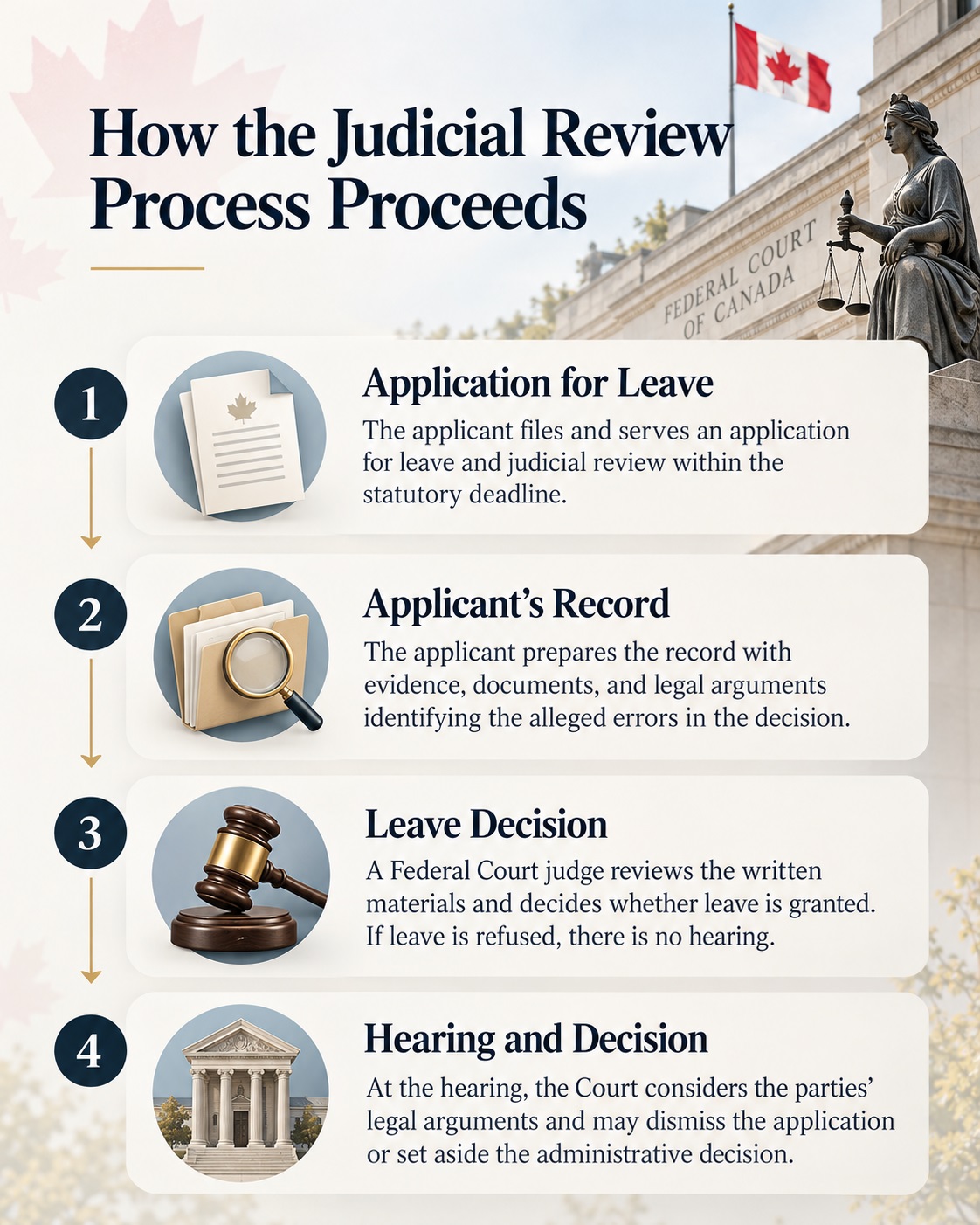
How Does the Judicial Review Process Proceed?
It is usually carried out through the following steps:
Step 1: Application for Leave
An application for leave and judicial review is filed and served by the applicant within the statutory period for the same.
Step 2: Record of the Applicant
The applicant prepares the record containing all evidence, documents, and legal reasoning showing the errors made in the decision.
Step 3: Granting of Leave
A judge of the Federal Court considers the written submissions and decides on granting leave. In case no leave is granted, there will be no hearing of the application for judicial review.
Step 4: Judicial Review Hearing and Decision
During the hearing, the Court evaluates the legal grounds of the parties and decides on the justification for judicial review. The Court could dismiss the application or allow the judicial review and overturn the administrative decision.
Are You Allowed to Stay in Canada for Judicial Review?
Applying for judicial review will not automatically stop your removal from Canada.
Under section 231 of the Immigration and Refugee Protection Regulations, a judicial review application that qualifies as a challenge to a negative RAD decision will automatically create a stay of removal order, except when specified otherwise under the statute. A judicial review of an RPD decision does not necessarily create a stay of removal. In the event of automatic stay not being granted, you may apply separately for a stay of removal before the Federal Court.
What Happens When There Is Success on Judicial Review?
In the event that the Federal Court issues an order of judicial review, the typical remedy is to quash the decision and remit the issue for further consideration. For instance, in the event that the Court quashes a negative decision from the RAD, the issue would likely go back to the RAD for redetermination, and not directly to the RPD.
Likewise, where the visa application was unreasonable, it can be remitted to an immigration officer for a new decision. A positive judicial review will not automatically lead to visa, permanent residency, or refugee status. It is only a chance for a new decision via legal process.
Canadian Judicial Review Case Law
The following are some of the landmark judgments in Canada that have influenced immigration judicial review:
· Singh v. Minister of Employment and Immigration, [1985] 1 SCR 177: A landmark case on fundamental justice in relation to refugee cases.
· Baker v. Canada, [1999] 2 SCR 817: Procedural fairness and administrative discretion in immigration matters.
· Canada v. Khosa, 2009 SCC 12: Case dealing with the issue of court supervision and reweighing of evidence from administrative process.
· Canada v. Vavilov, 2019 SCC 65: Provides the modern framework of reasonableness review.
· Mason v. Canada, 2023 SCC 21: Case in which reasonableness standards have been applied to statutory interpretation in an immigration inadmissibility case.
These cases assist in defining the boundary between administrative discretion and decisions that warrant judicial intervention.
Frequently Asked Questions
Is judicial review similar to an immigration appeal?
No. Judicial review reviews whether an administrative decision was legal, reasonable, and conducted in a procedurally proper manner. Usually, it is not a re-hearing of the original immigration application.
Can the Federal Court overrule RPD/RAD denial?
Yes. Upon identifying a reviewable error, the Court can quash the decision and remit it for reconsideration to the appropriate tribunal.
Does an application for judicial review delay deportation?
Maybe. Some types of judicial reviews of RADs automatically receive regulatory stays, while others need a separate court order to prevent deportation.
Can a denied visa be granted following judicial review?
After a successful judicial review, a decision may be overturned, and the case may be reconsidered; however, approval is not automatic.
Can an immigration consultant represent a person in Federal Court?
Being licensed as an immigration consultant does not provide the person with authorization to act as legal counsel before the Federal Court.
Conclusion
Judicial review is an essential aspect in Canada’s immigration and refugee system as it involves reviewing administrative decisions for compliance with law and fairness in process.
When one is challenging the decision to deny an immigration application or a decision of the RPD or RAD, the critical factors include the existence of reviewable error, the statutory limitation period, and the possible remedy from the Court. While judicial review cannot secure an immigration win for the individual, it can lead to reversal of an unlawful and unreasonable decision.