
Canadian Federal Court Quashes Decision to Refuse Immigration Based on Repetitive Reasons
The Canadian Federal Court has quashed a decision to refuse immigration based on a finding that the process involved failed to reflect an independent assessment of the situation.
This is in Lali v. Canada (Citizenship and Immigration), 2026 FC 1245, where the Court examined the refusal to resettle an Afghan national for a second time in Canada. One of the key problems was the remarkable similarities between the reasons for the refusal and the previous refusal decision.
What Occurred in This Case?
The claimant, who is an Afghan national living in Turkey, applied to settle in Canada. The claim was denied at first but then sent back to be reconsidered.
It fell upon another immigration officer to consider the issue again. In the process, much of the analysis in the second denial mirrored the previous one. This time, however, the claimant appealed this decision in Federal Court on the grounds that his case was not independently considered.
Procedural Unfairness in Preparing the Second Decision
The Federal Court also found that there was procedural unfairness in the way the second decision was made. It determined that a great deal of the reasoning in the new decision had essentially been duplicated from the previous refusal decision, with minor changes.
This was not the issue of two immigration officials arriving at the same decision based on the same set of facts. It is reasonable for different decision-makers to make a similar decision on the same set of facts. What was problematic was whether the second official carried out the necessary independent review when reconsidering the decision.
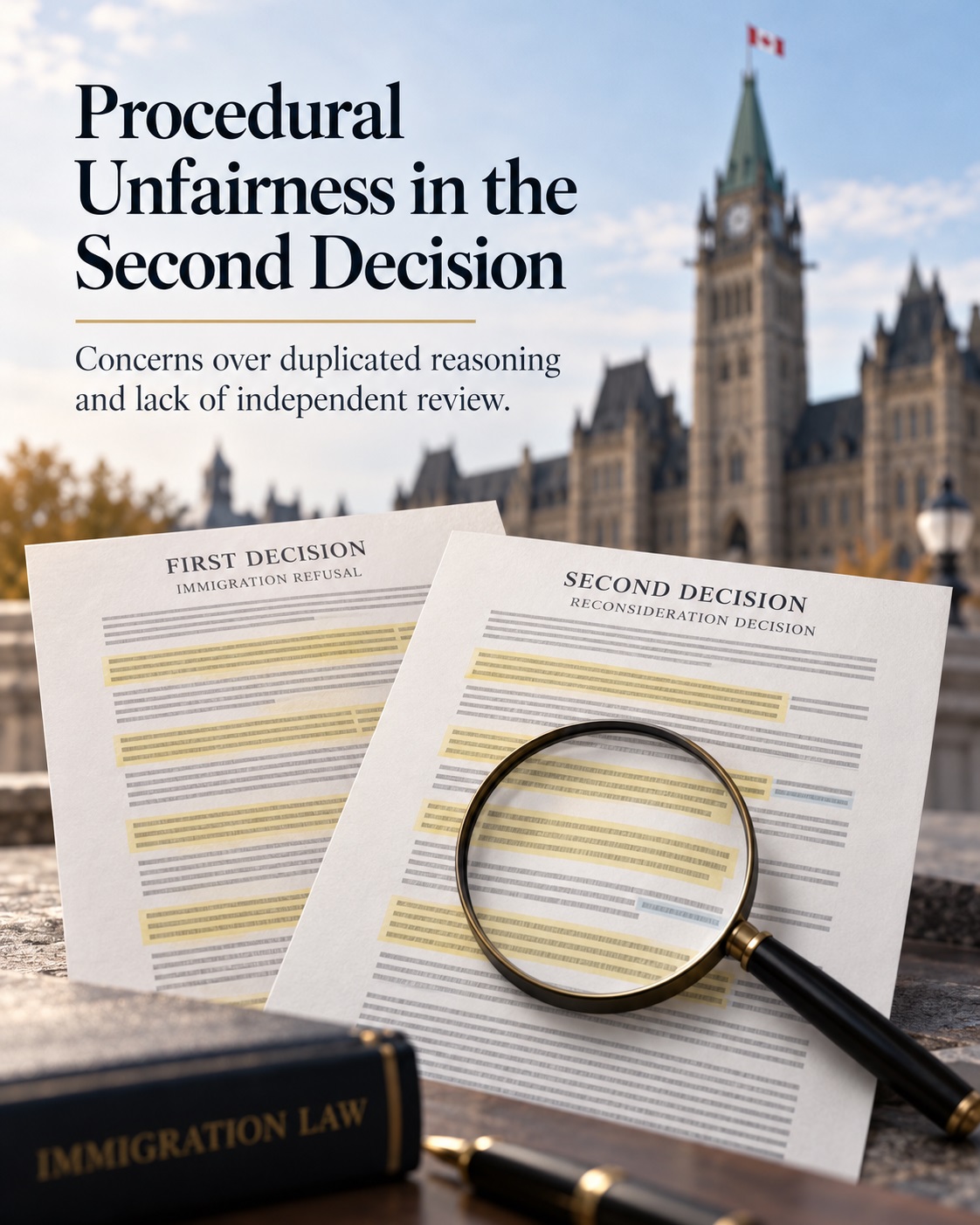
The Importance of Independent Reconsideration
Where a decision is quashed and remitted for reconsideration, reconsideration must involve more than merely a formal process. The decision-maker needs to look at the evidence and circumstances of the application, and decide on that basis.
Language similarities do not necessarily mean that an immigration decision is void. The use of standard language and even some overlap in reasoning would sometimes be reasonable, especially where the evidence has not changed. It becomes an issue when there is significant repetition of an earlier decision, which might suggest a lack of independent reconsideration of the case.
What did the Federal Court decide?
The Court allowed the application for judicial review and quashed the decision to refuse the application. Therefore, the immigration application will have to be reconsidered.
This decision affirms one of the key principles of Canadian administrative law: that of an entitlement to a genuine process of decision-making, especially in circumstances where the decision was previously quashed and reconsidered.
What Does This Mean for Canadian Immigration Applicants?
It does not mean that every immigration refusal decision, which includes standard language or repetitive reasons, can be reviewed. However, it shows that the Federal Court will consider a case where reasons reveal that the decision-maker did not independently review the matter.
When evaluating the refusal decision, some of the issues that might be relevant for the applicant could be:
· reasons that do not take into account significant evidence;
· reasons that seem to be disconnected from the applicant's unique situation;
· significant replication of the reasons in a previous decision that the Court has overruled; and
· indication that the decision was made without individualized assessment.
Each case is unique, and these issues may not constitute judicial review.

Procedural Fairness in Immigration Decision-making
Canadian immigration officials have a significant amount of power in the process of making decisions regarding applications, but the decisions of those officials are still subject to judicial review.
A federal court review is not supposed to make a new decision about an immigration application. The Court reviews the administrative decision to determine whether it was made lawfully, rationally, and with procedural fairness in mind.
In the case of Lali v. Canada, one can see that the new consideration has to be substantial. When the decision-maker has to reconsider the application, it has to show that it has taken into account all evidence, instead of simply repeating the previous consideration.
Case: Lali v. Canada (Citizenship and Immigration), 2026 FC 1245
Court: Federal Court of Canada
Date of Decision: October 9, 2026