Canada Visa Refusal Due to Financial Insufficiency: What It Means and What You Can Do?
A Canada visa refusal due to financial insufficiency can occur when an immigration officer is not satisfied that an applicant has enough financial resources to support their proposed stay in Canada.
Financial concerns can arise in applications for a Temporary Resident Visa (TRV), study permit, work permit, or other Canadian immigration applications. However, having money in a bank account does not necessarily resolve the issue. Officers may consider the amount of available funds, the source of those funds, the applicant's financial circumstances, and whether the proposed expenses in Canada are realistic.
If your Canada visa was refused because of insufficient funds or financial concerns, understanding exactly why the officer was not satisfied is important before deciding whether to reapply or challenge the refusal.
What Does Financial Insufficiency Mean in a Canada Visa Refusal?
In a temporary residence application, an officer generally needs to be satisfied that the applicant has sufficient financial resources for the purpose and duration of their proposed stay.
Depending on the application, this can include the ability to cover expenses such as:
Travel to and from Canada
Accommodation
Daily living expenses
Tuition and educational expenses for students
Expenses for accompanying family members
Other costs associated with the proposed stay
The officer may also examine whether the applicant's financial situation is consistent with the purpose of the application.
For example, an applicant proposing an extended visit to Canada may face concerns if their available funds appear insufficient to reasonably cover the cost of that trip.
Why Can a Canada Visa Be Refused for Insufficient Funds?
A refusal based on financial circumstances can arise for different reasons. It is therefore important not to assume that every financial refusal can be resolved simply by submitting a larger bank balance.
Common concerns may include:
Insufficient available funds
The amount demonstrated may not reasonably cover the expected expenses associated with the proposed stay in Canada.
Unexplained large deposits
A significant amount deposited shortly before an application may raise questions about where the money came from and whether it is genuinely available to the applicant.
Unclear source of funds
An applicant may show a substantial bank balance but provide limited evidence explaining how those funds were accumulated.
Income that does not correspond with the available funds
If the applicant's employment income, business income, or financial history appears inconsistent with the amount claimed as available funds, the officer may have concerns.
Reliance on a sponsor without sufficient supporting evidence
Where another person will pay for the applicant's trip, studies, or living expenses, the application may need evidence demonstrating both the sponsor's ability and genuine commitment to provide that support.
An unrealistic financial plan
The officer may consider whether the proposed budget makes sense given the length and purpose of the applicant's stay.
How Much Money Do You Need for a Canada Visa?
There is no single financial amount that applies to every Canadian visa application.
The appropriate level of funds depends on factors such as the type of application, length of stay, destination, accommodation arrangements, number of accompanying family members, and purpose of travel.
Study permit applicants are also subject to specific financial requirements relating to tuition, living expenses, and transportation.
For a visitor visa application, the financial analysis is more contextual. A person visiting family for two weeks may have very different financial requirements from someone planning a several-month stay.
This is why the strength of financial evidence should generally be assessed in relation to the applicant's specific circumstances rather than simply by looking at the final balance appearing on a bank statement.
What Financial Documents Can Support a Canada Visa Application?
The appropriate documents depend on the applicant's individual circumstances, but financial evidence may include:
Bank statements
Employment letters
Pay statements
Tax records
Business ownership documents
Business financial statements
Investment records
Proof of property or other assets
Evidence explaining significant deposits or transfers
Proof of tuition payments
Scholarship or educational funding documents
Sponsor's financial documents
Evidence establishing the relationship between the applicant and financial sponsor
The objective is not necessarily to submit as many financial documents as possible. The evidence should present a coherent picture of where the money comes from, whether it is genuinely available, and whether it is sufficient for the proposed stay in Canada.

What If There Was a Large Deposit in Your Bank Account?
Large or recent deposits can become an important issue in Canadian visa applications.
A large deposit does not automatically mean that an application should be refused. However, if its source is unclear, an officer may question whether the funds actually belong to the applicant or were temporarily transferred for the purpose of demonstrating financial capacity.
Where there are legitimate large deposits, supporting documentation can be important.
For example, depending on the circumstances, an applicant might provide evidence showing that the funds came from the sale of property, business income, an investment, accumulated savings, a family transfer, or another legitimate source.
The documentation should allow the officer to understand the financial transaction rather than requiring the officer to speculate about its origin.
Can Someone Else Sponsor Your Trip to Canada?
In appropriate circumstances, an applicant may rely on financial support from another person.
However, simply providing a sponsorship letter may not be sufficient.
The application may need to demonstrate:
Who the sponsor is;
The relationship between the sponsor and applicant;
Why the sponsor is providing financial support;
The sponsor's ability to provide that support; and
Evidence that the proposed funds are actually available.
Depending on the circumstances, relevant evidence may include the sponsor's bank statements, employment information, tax documents, proof of relationship, and a written explanation of the financial arrangement.
What If the Visa Officer Ignored Your Financial Evidence?
There is an important distinction between an application that did not contain sufficient financial evidence and one where substantial relevant evidence was submitted but was not reasonably addressed in the decision.
Visa officers are not necessarily required to specifically discuss every document submitted with an application.
However, depending on the circumstances, a refusal may potentially be challenged where the decision fails to meaningfully account for important evidence that directly contradicts the officer's financial concerns.
This becomes particularly important where the applicant provided clear evidence addressing the exact issue relied upon in the refusal.
Should You Reapply After a Canada Visa Refusal for Insufficient Funds?
Reapplication can be appropriate where there was a genuine weakness in the original application.
For example, if the source of funds was poorly documented, important bank records were missing, or a sponsor's financial position was not properly established, a new application may allow the applicant to address those weaknesses.
However, submitting essentially the same application again may result in another refusal.
Before reapplying, it is useful to determine:
What financial concern caused the refusal;
What evidence was originally submitted;
Whether important information was missing;
Whether the officer misunderstood or overlooked material evidence; and
What new evidence or explanation can directly address the concern.
Can You Appeal a Canada Visa Refusal Based on Financial Insufficiency?
There is generally no direct appeal to the Immigration Appeal Division for an ordinary visitor visa, study permit, or work permit refusal.
However, an applicant may potentially challenge a refusal through an Application for Leave and Judicial Review at the Federal Court of Canada.
Judicial review is different from submitting a new visa application. The Federal Court does not normally reassess the application and decide whether the applicant should receive a visa.
Instead, the Court reviews whether the immigration decision was legally reasonable and procedurally fair.
If the Court finds a reviewable error, it may set aside the refusal and return the application for redetermination, generally by a different decision-maker.
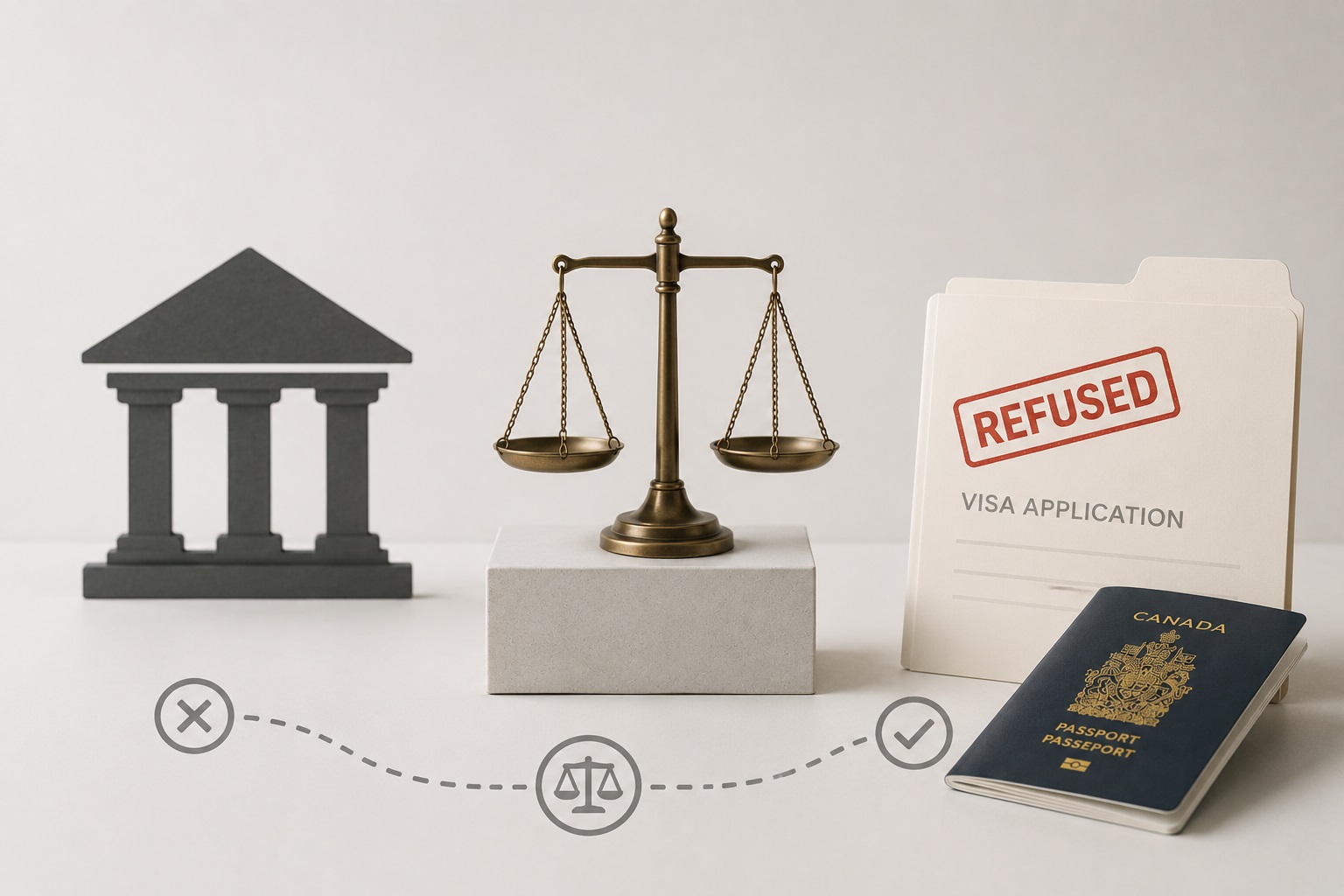
Reapplication or Judicial Review: Which Is Better?
The answer depends on why the application was refused.
Reapplication may be appropriate when the original application genuinely lacked sufficient financial evidence and the problem can be corrected with stronger documentation.
Judicial review may be worth considering where significant financial evidence was already before the officer but the decision appears unreasonable, important evidence may have been overlooked, or there may have been a procedural fairness issue.
In some cases, applicants may also need to consider the strategic implications of pursuing judicial review while preparing a stronger application.
The appropriate approach depends on the refusal reasons, the officer's notes, the evidence submitted with the original application, applicable deadlines, and the applicant's circumstances.
How Visa Appeal Can Help With a Financial Insufficiency Refusal
Assess a financial insufficiency refusal against the evidence actually before the immigration officer.
At Visa Appeal, our immigration lawyers can review your refusal decision and application materials to determine whether a stronger reapplication is better or whether you have grounds to challenge the decision before the Federal Court of Canada.
If judicial review is appropriate, our legal team can assist throughout the Federal Court process.
If your Canada visa, study permit, or work permit was refused because of insufficient funds or financial concerns, send us your refusal decision for an assessment.