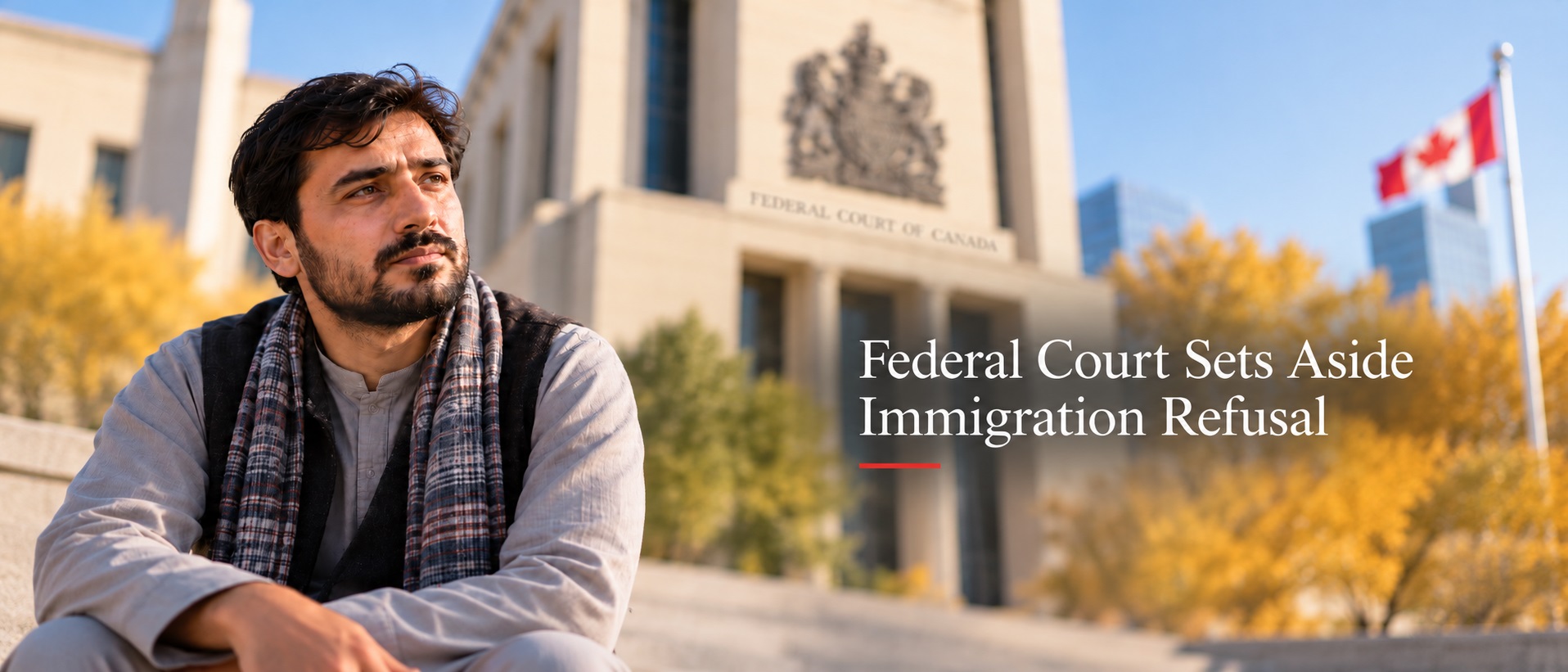
Federal Court Overturns Canadian Refugee Resettlement Refusal Over Durable Solution Finding
Refusal to Resettle Refugees Overturned in Federal Court: The Problem with “Rights on Paper”
In a recent case from the Federal Court of Canada, the problem with rights on paper is made clear – even if a person has legal rights within a country, he or she may still be denied a practical and sustainable existence in that country.
In Ghebriel Yosief v. Canada, 2026 FC 1130, the Federal Court considered an appeal against the refusal of an application for permanent residency pursuant to the Convention Refugees Abroad or Humanitarian-Protected Persons Abroad Class. The refusal was based on the finding that the applicant had a “durable solution” in South Africa.
The Federal Court rejected this position and held that it was unreasonable.
What Was the Problem in the Case?
The applicant was an Eritrean national who escaped persecution due to her religious views. The applicant, along with her family members, was declared a refugee in South Africa and then applied for refugee resettlement to Canada.
The decision of the immigration officer was that since they enjoyed the recognition of their refugee status in South Africa and certain legal benefits from that, they could claim that there existed a durable solution for them.But according to the applicant, the facts on the ground were entirely different from the legal status.
This included issues regarding:
· employment;
· discrimination and xenophobia;
· security problems;
· family separation; and
· inability to unite with their two children, who resided outside South Africa.

Federal Court: A Legal Status is Not Always a Durable Solution
It was noted that the consideration of a durable solution should not be based solely on the formal rights granted by the laws.
A decision-maker has to take into account:
· the situation of the applicant;
· living conditions;
· possibility of exercising such rights;
· integration prospects in the receiving state.
The study argues that in this case the officer placed a great deal of importance on the fact that refugees in South Africa were entitled to employment, yet did not pay proper attention to the applicant’s arguments about the impossibility of obtaining formal employment because of practical difficulties.This is one of the crucial aspects of the assessment of a durable solution.
Importance of Evidence in Refugee Resettlement Cases
In this particular case, one can understand the importance of more specific information to be provided by refugees for their asylum cases in addition to generic country information.
An applicant should provide clear evidence regarding the following aspects:
· ✅ Individual situation
· ✅ Obstacles that an applicant faces in their country of residence
· ✅ The problem of family separation
· ✅ Social and economic problems
· ✅ Why a hypothetical legal right may fail to represent a realistic situation for an applicant
Case Returns to Be Decided Again by the Federal Court
The judicial review was granted, the refusal was set aside, and the case returned to a new decision-maker. Additional submissions were also allowed by the applicant.

The Implications for Refugees and Immigrants
A refusal decision that cites a “durable solution” could be appealed where the decision does not take into account the situation of the applicant.
In cases where a refusal of your resettlement or humanitarian application takes place, a Judicial Review of the decision could be considered at the Federal Court of Canada.
Visa Appeal assists refugees and immigrants who need help understanding their options after a Canadian immigration refusal.