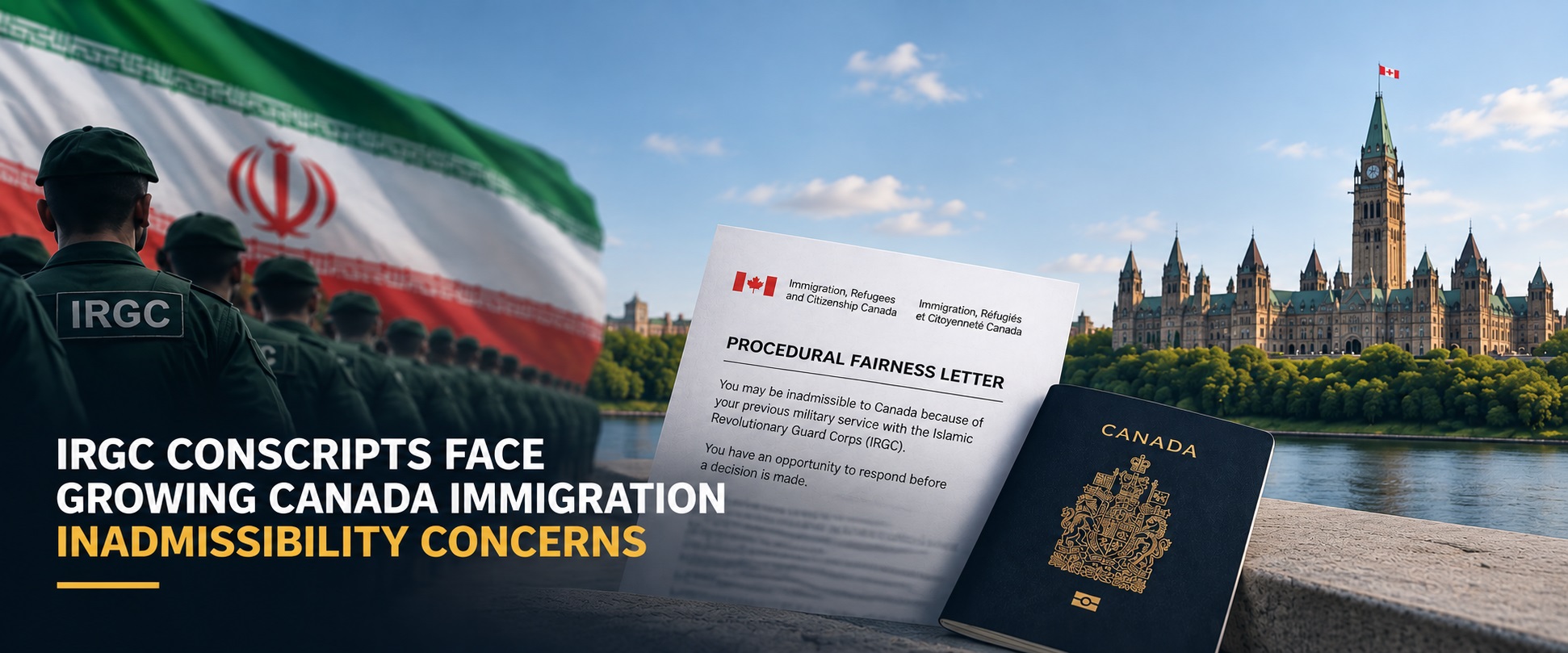
Iranian IRGC Conscripts Face Growing Canada Immigration Inadmissibility Concerns
Many Iranian immigrants who are based in Canada could soon be denied entry into the country on the grounds that they have been obliged to perform military service in Iran, including for the Islamic Revolutionary Guard Corps (IRGC).
According to reports, hundreds of Iranian applicants have already received procedural fairness letters (PFLs) in August informing them that their past military service raised concerns about their admissibility to Canada. The issue is now of great importance to many Iranian applicants who have outstanding permanent residence or other immigration requests, including those who served in the Iranian military years ago.
Why Is IRGC Military Service Harming Canadian Immigration Applications?
Military service is compulsory for many Iranian men. According to the assignment system in place at the time of the draft, some men were sent to serve in the Islamic Revolutionary Guard Corps instead of another division of Iran’s military. This creates a complex immigration conundrum for Canadians.
Canada officially designated the Islamic Revolutionary Guard Corps as a terrorist entity according to the Criminal Code on June 19, 2024. Canadian immigration law also contains security inadmissibility clauses applicable to foreign nationals and permanent residents in the case of terrorism and organization membership.
As a result, a former member’s alleged past affiliation with the IRGC may receive particularly scrutinizing attention in the course of Canada’s immigration and security screening procedures. The main problem for many ex-cons is that service was supposedly mandatory, not voluntary.
Procedural Fairness Letters Sent to Iranian Applicants
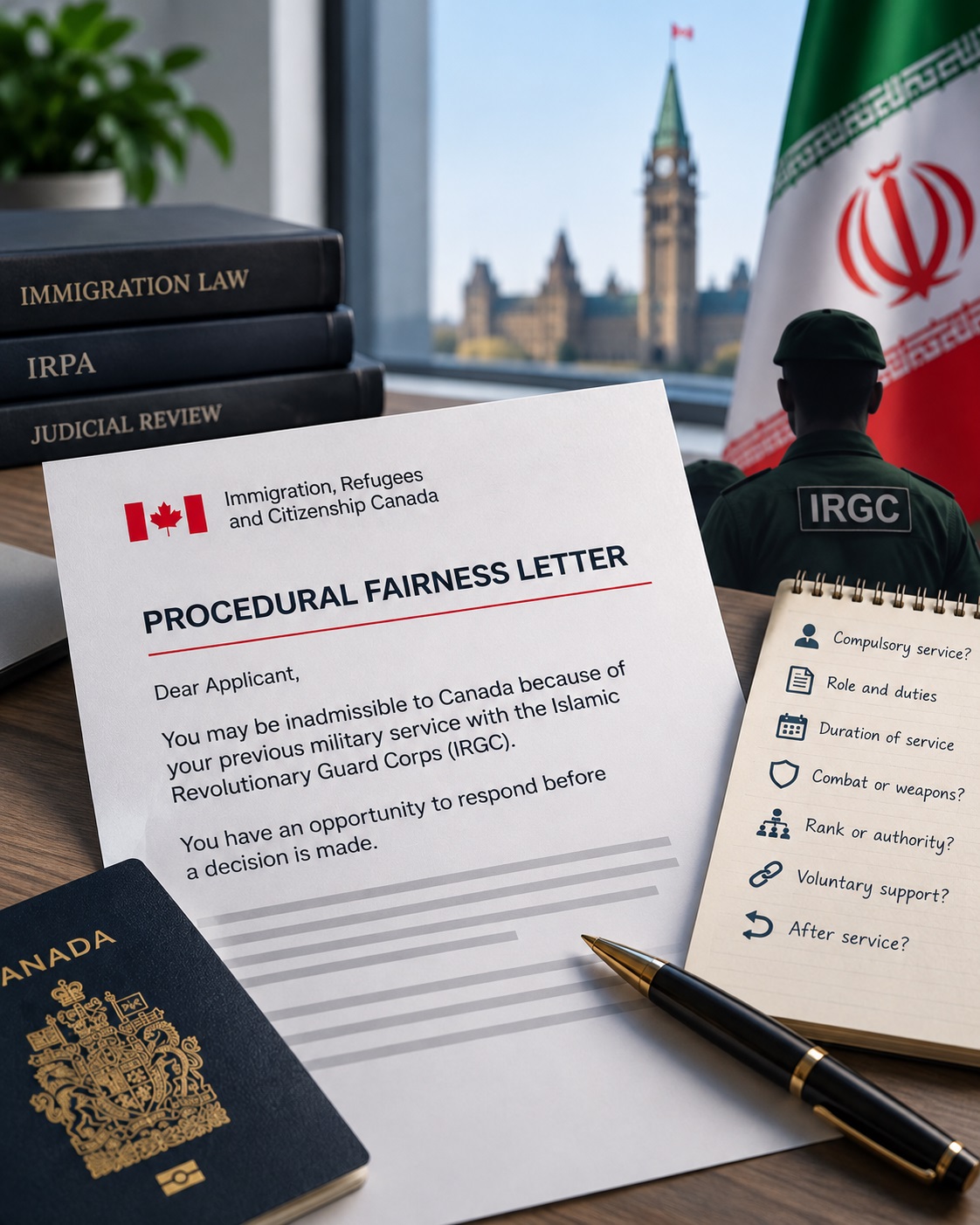
A growing number of Iranian applicants have reportedly received procedural fairness letters concerning their previous compulsory military service. A procedural fairness letter generally gives an applicant an opportunity to address concerns before immigration authorities make a final decision.
For former Iranian conscripts, responding to such a letter may involve explaining circumstances such as:
· whether the military service was compulsory;
· how the person was assigned to the IRGC;
· the nature and duration of the service;
· the person's actual responsibilities;
· whether the person carried weapons or participated in combat;
· whether the person had decision-making authority or rank;
· whether the person voluntarily supported the organization; and
· what the person did after completing compulsory service.
These distinctions can be important because the circumstances of one former conscript may be substantially different from those of another.
Former Conscripts Say Their Service Was Involuntary
Some affected applicants reportedly disclosed their compulsory IRGC service when they originally submitted their Canadian immigration applications. They are concerned that the service that they did not voluntarily choose may now impact their application even if they were only performing administrative, technical, clerical, or other non-combat duties.
The implications of an inadmissibility finding can be significant to a person depending on their immigration status and circumstances. It may affect a permanent residence application, temporary immigration status, or the person's ability to remain in Canada. It can also impact their accompanying family members when their immigration applications are connected to the principal applicant.
Canada's IRGC Designation and Immigration Screening
The Canadian government's addition of IRGC to the list of terrorist entities in 2024 was part of a larger trend of action against the Iranian government and the IRGC.
The federal government has separately asserted that all foreign individuals applying for entry or immigration into Canada must satisfy the admissibility requirements of the Immigration and Refugee Protection Act (IRPA). Government briefing materials specifically on Iran cite terrorism and issues of membership or affiliation as potential grounds of inadmissibility.
The existence of compulsory military service, however, raises a difficult legal question: when does mandatory service constitute membership for Canadian immigration purposes? That question is of increasing importance for Iranian applicants.
Federal Court Decision on Mandatory Service in IRGC
One of the significant cases concerns the Federal Court’s consideration of the immigration admissibility issues of former IRGC conscripts.
In Vadiati v. Canada (Citizenship and Immigration), 2025 FC 1859, the Court was asked to interpret the connection between compulsory service in the Islamic Revolutionary Guard Corps (IRGC) and the corresponding membership for the purpose of immigration inadmissibility. The case is of great interest to those who were forced to perform their service and to those whose only connection with the Iranian organization was their recruitment.
At the same time, immigration cases are considered on a purely individual basis, and the fact that one applicant received a positive result does not mean that all who serve in the IRGC will be welcomed as immigrants. To each application, the authorities bring individual arguments that the applicant must carefully consider. The problems of military service, compulsory service, and employment in the IRGC are significant, and the issues to be decided are relevant for both the applicant and the state.
Individual Circumstances Remain Important
Canadian administrative decision-makers are generally required to take into account the evidence and legal framework that applies to the particular case before them.
The Supreme Court of Canada's decision in Mason v. Canada (Citizenship and Immigration), 2023 SCC 21, is an important authority on security admissibility and reasonable administrative decision-making. In that case, the Supreme Court overturned immigration inadmissibility decisions after determining that the interpretation applied to the relevant security provision was unreasonable.
Although Mason concerned a different provision and factual context, it highlights the importance of interpreting Canada's security inadmissibility provisions in accordance with their statutory context and of making reasonable administrative decisions. As a result, for applicants facing IRGC-related concerns, the specific evidence concerning the individual's own military service may therefore be critical.

Other Countries Have Considered Compulsory Service Separately
Treatment of mandatory Iranian military service has also drawn the attention of the authorities in countries other than Canada. The jurisdictions cited examples of state information or policy documents addressing the distinction between compulsory conscription and voluntary participation in the IRGC.
These approaches do not determine how Canadian immigration law must be interpreted. However, it demonstrates the problem governments have faced when assessing people whose formal association with a military or security organization was the result of compulsory national service.
Families May Also Be Affected
The repercussions may have implications for more than the former conscript.
Where spouses and children are included in a permanent residence application, issues affecting the principal applicant may negatively impact the processing of the family's applications. For families already residing in Canada, prolonged uncertainty in respect of immigration status can also have practical implications for employment, work authorization, education, and long-term settlement planning.
What Should You Do If You Receive an IRGC Procedural Fairness Letter?
Receiving a procedural fairness letter concerning IRGC military service does not necessarily mean that a final inadmissibility decision has already been made. The response stage provides an important opportunity to address the government's concerns and provide relevant evidence.
Applicants may need to document carefully:
· why the military service was compulsory;
· how they were assigned to the IRGC;
· their actual position and responsibilities;
· whether they had any operational, combat, or security role;
· whether they voluntarily participated in IRGC activities;
· documents confirming the dates and nature of their service; and
· other evidence relevant to their individual circumstances.
Because security inadmissibility can have serious immigration consequences, applicants should understand precisely what allegations or concerns have been raised before preparing their response.
Can an IRCC Inadmissibility Decision be Challenged in Federal Court?
Depending on the circumstances of your case, if your application for immigration was denied, you may be able to apply for judicial review with the Federal Court of Canada.
Judicial review is not an immigration application. It is a legal process where the Court looks at the decision of the IRGC and finds it to be reasonable or not. Possible grounds for review include whether the IRGC decided the matter reasonably based on the evidence, applied the relevant provisions of the IRPA correctly, made proper findings of fact in response to submissions made by you, and gave you a fair hearing.
There are many factors that go into considering a Judicial Review. The best course of action will depend on the specific decision being reviewed and your individual circumstances.
IRGC Conscription Becomes Issue for Canadian Immigration Applicants
The increasing number of reports of procedural fairness letters suggests that mandatory IRGC military service is becoming an increasingly important issue for Iranian immigration applicants in Canada. Canada has legitimated national-security screening requirements, and the federal government has taken extensive measures regarding the IRGC. At the same time, compulsory military service raises separate factual and legal issues for those who claim they did not voluntarily join or support the organization.
For affected applicants, distinguishing between mandatory conscription and voluntary involvement may therefore be crucial to how their immigration history is interpreted. Applicants who receive a procedural fairness letter or an inadmissibility decision relating to former IRGC service should therefore carefully examine the allegations, supporting evidence, and applicable Canadian immigration law before deciding their next steps.