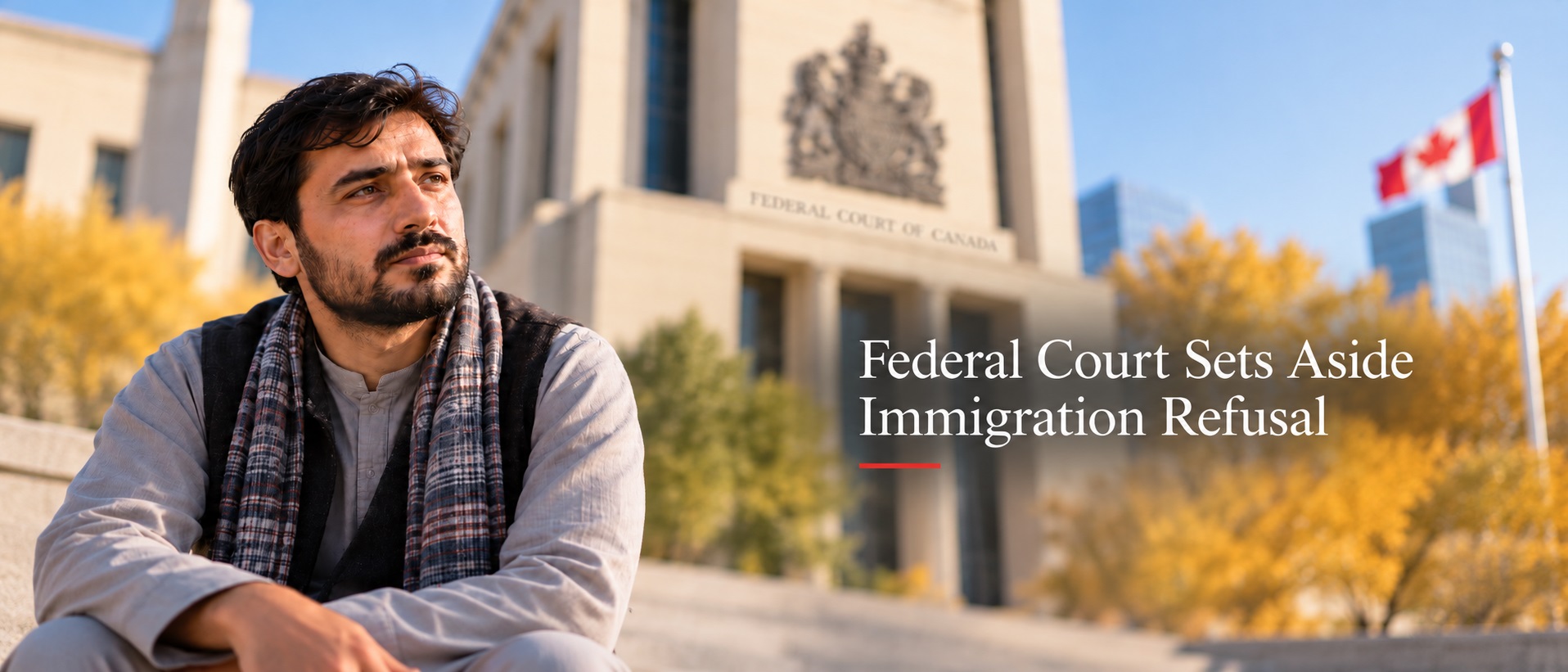
Federal Court Sends Refugee Appeal Back Over Credibility Findings
One recent case in the Federal Court brings forward the fundamental issue of refugee law in Canada: a credibility assessment has to be made based on evidence and logical reasoning.
In Ramirez v. Canada (Citizenship and Immigration), 2026 FC 1197, the Federal Court granted leave to appeal a decision by the Refugee Appeal Division (RAD). It remanded the case back to a new decision-maker. The issues in the case include inappropriate consideration of credibility that was based on assumptions concerning the actions of the refugee claimants instead of the evidentiary record.
What Happened in Ramirez v. Canada?
The applicants were Mexican nationals who ran a restaurant in Mexico City. According to their application, they were solicited by people affiliated with a criminal gang who offered them high-interest loans. However, the applicants refused these offers, leading to an escalation in the situation where they feared for their safety.
The applicants' refugee claim was denied by the RPD, which was upheld in its entirety. Recordability was a major aspect on which the RAD focused, such as discrepancies in timelines and the applicants' behaviour. The applicants filed a judicial review of their case in the Federal Court of Canada.
What Made the Federal Court Think that the RAD Decision Was Not Reasonable?
In its judgment, the Federal Court argued that the reasons given by the RAD lacked a rational and convincing rationale for refusing to consider the application. The main problem was related to findings of implausibility. For instance, the RAD expressed doubts about why the applicants failed to use security cameras in their restaurant and why they did not transfer their business elsewhere.
Nevertheless, there were no indications about whether this was possible for the applicants, and the applicants had not been asked to address these issues. Thus, such conclusions depended on the expectation of the decision maker.
Credibility Decisions Need to Be Supported by Evidence
Credibility is frequently crucial in refugee determination hearings.
It is legitimate for the RPD and RAD to consider inconsistencies, contradictions and other flaws in the testimony or evidence of the claimant. But even though it may be difficult, a negative credibility decision needs to be based on the evidence.
A tribunal is not allowed to disregard the testimony of the claimant merely because the claimant behaved contrary to the personal expectations of the decision-maker. This applies especially when an implausibility finding is made. Just because something seems odd, it doesn’t necessarily mean that it didn’t happen.
Are Minor Inconsistencies in One’s Story Sufficient to Render the Refugee Claim Untrue?
No.
One of the issues that the Court considered in relation to the RAD included how it handled the inconsistencies in relation to the chronology of events. While an inconsistency may be taken into account by the decision-maker, they must indicate the reason why it is relevant to the claim.
A discrepancy regarding the date or the order of events should not automatically lead to rejecting the crucial aspects of the refugee claim.

Clear Reasons for a Refugee's Case
According to the Canadian Supreme Court in Canada (Minister of Citizenship and Immigration) v. Vavilov, 2019 SCC 65, reasons for administrative decisions have to be reasonable, intelligible, and justified.
It is meant that when the person reads the decision, they can figure out:
· what evidence was considered;
· what evidence was not considered;
· the importance of the problem of the credibility of the witnesses; and
· how it resulted in the outcome.
Despite the length of the decision rendered by the RAD, in Ramirez, the Federal Court stated that there was no clear link between the evidence, the credibility of the witnesses, and the refusal of the refugee claim.
What Happens Once Judicial Review is Allowed?
It is not the usual role of the Federal Court to determine whether the applicants are to be granted refugee status. Rather, judicial review determines whether the decision was reasonable and made in accordance with the law.
As such, because the Federal Court determined that the decision of the RAD was unreasonable, it quashed that decision and remitted the issue back to the RAD for re-determination by another decision-maker. It means that a new decision-maker from the RAD has to reassess the situation and make a new decision. Therefore, a judicial review does not automatically mean that the applicants will be granted refugee status.
What Does this Case Signify for Refugee Applicants in Canada?
There are many lessons from Ramirez v. Canada for refugees who seek asylum in Canada.
The first lesson is that a negative credibility assessment must not be based on assumptions about what an applicant ought to have done. Significant findings must always be founded on evidence, and inconsistencies must always be analysed in the light of the entire claim.
The most crucial lesson is that the decision must give the applicant, and ultimately a court on judicial review, an understanding of the basis of the decision. Where the RAD denies a refugee application based on unsupported credibility assessments, or conclusions that lack clarity or connection to the evidence, the applicant can apply for judicial review of the decision to the Federal Court.
Can you Challenge a Negative RAD Decision?
In certain circumstances, a negative Refugee Appeal Division decision may be reviewed via an Application for Leave and Judicial Review at the Federal Court level.
It would depend on the particular circumstances of each case, but possible grounds could include:
· credibility findings not supported by the record;
· implausibility findings made without proper foundation;
· not addressing all relevant evidence;
· contradictory analysis by the decision-maker; or
· procedural unfairness.
As the proceedings at the Federal Court are strictly time-barred, one should seek legal advice as soon as a negative decision is received.

Refugee Claim Denial Under Question?
For those who have had their refugee claim or RAD appeal denied, Visa Appeal can conduct an evaluation and determine if there is potential for judicial review of the case by the Federal Court.
📞 +1 249 500 5807
Visa Appeal — Your appeal. Our expertise. Your victory.