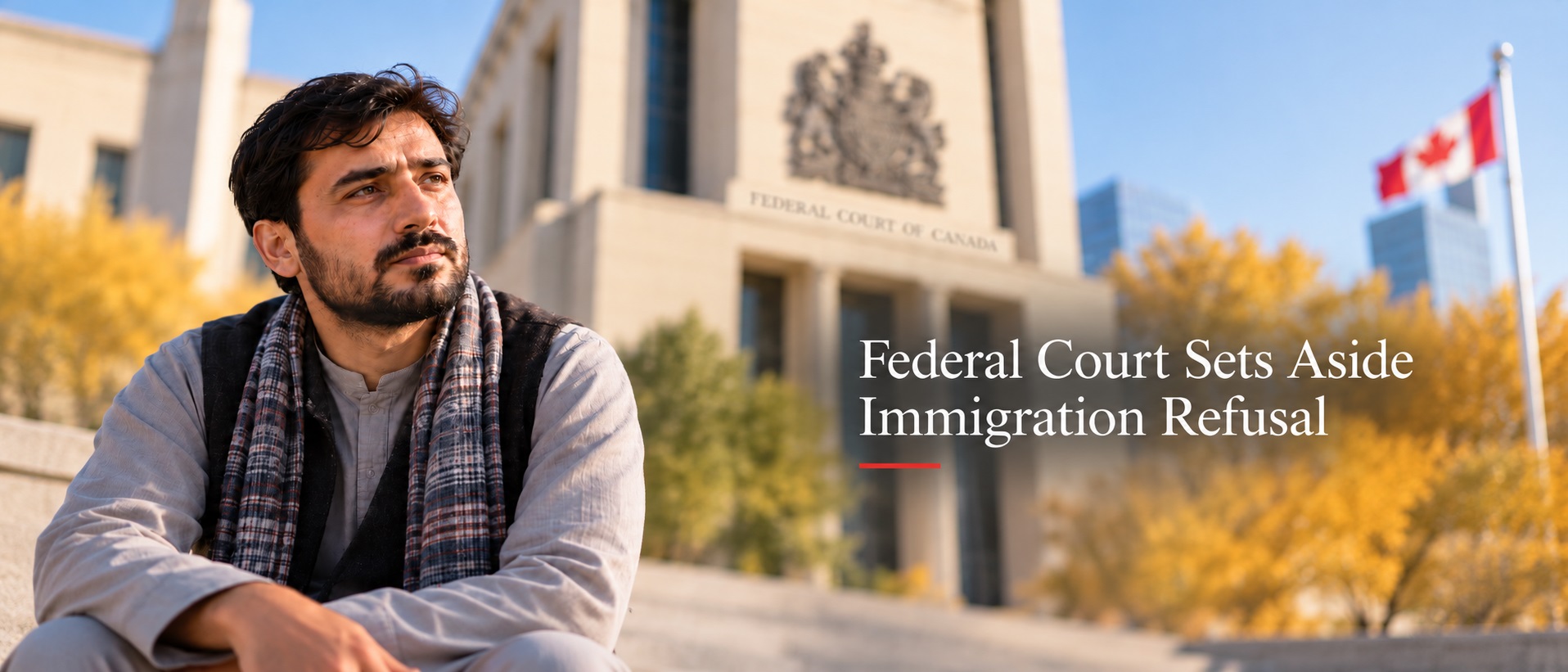
Canada Refusal Letter: What It Means and What to Do?
Receiving a Canada refusal letter from IRCC can be challenging. Whether IRCC refused your visitor visa to Canada, study permit, work permit, permanent resident application, or sponsor application, consulting a legal professional or immigration consultant early can help you understand your options and avoid common pitfalls. One major question you need to address now is which step to take next.
While a refusal by IRCC does not automatically imply that you no longer have opportunities to immigrate to Canada, depending on the type of application, reasons for refusal, and specifics of your case, you may be able to:
• file a request for reconsideration;
• make a better application; or
• launch an appeal against the refusal if there is a statutory right of appeal.
Before taking any of the above actions, you need to understand why IRCC refused the application. Understanding the reasons can help you feel more confident and in control of your next steps, especially if the refusal letter cites several grounds.
What Is a Canada Refusal Letter?
A Canada refusal letter is the document in which an applicant is informed that their Canadian immigration application has been refused.
Depending on the type of application, such concerns as, for example:
• reasons for traveling;
• the absence of sufficient financial support or means;
• the lack of strong connections to the family, work or economy;
• issues with the applicant’s intention to leave Canada at the end of the allowed period;
• the absence of enough information in support of the application or its inconsistency;
• the failure to comply with the conditions of the program;
• misrepresentation;
• inadmissibility (criminal, security or other issues).
may be identified.
The reasons for refusal are not always fully disclosed in the refusal letter. Sometimes a single case lists several reasons when there was only one main reason for refusal.
That is why analyzing a Canadian immigration refusal requires more than just reading the Canada refusal letter and checking the boxes.
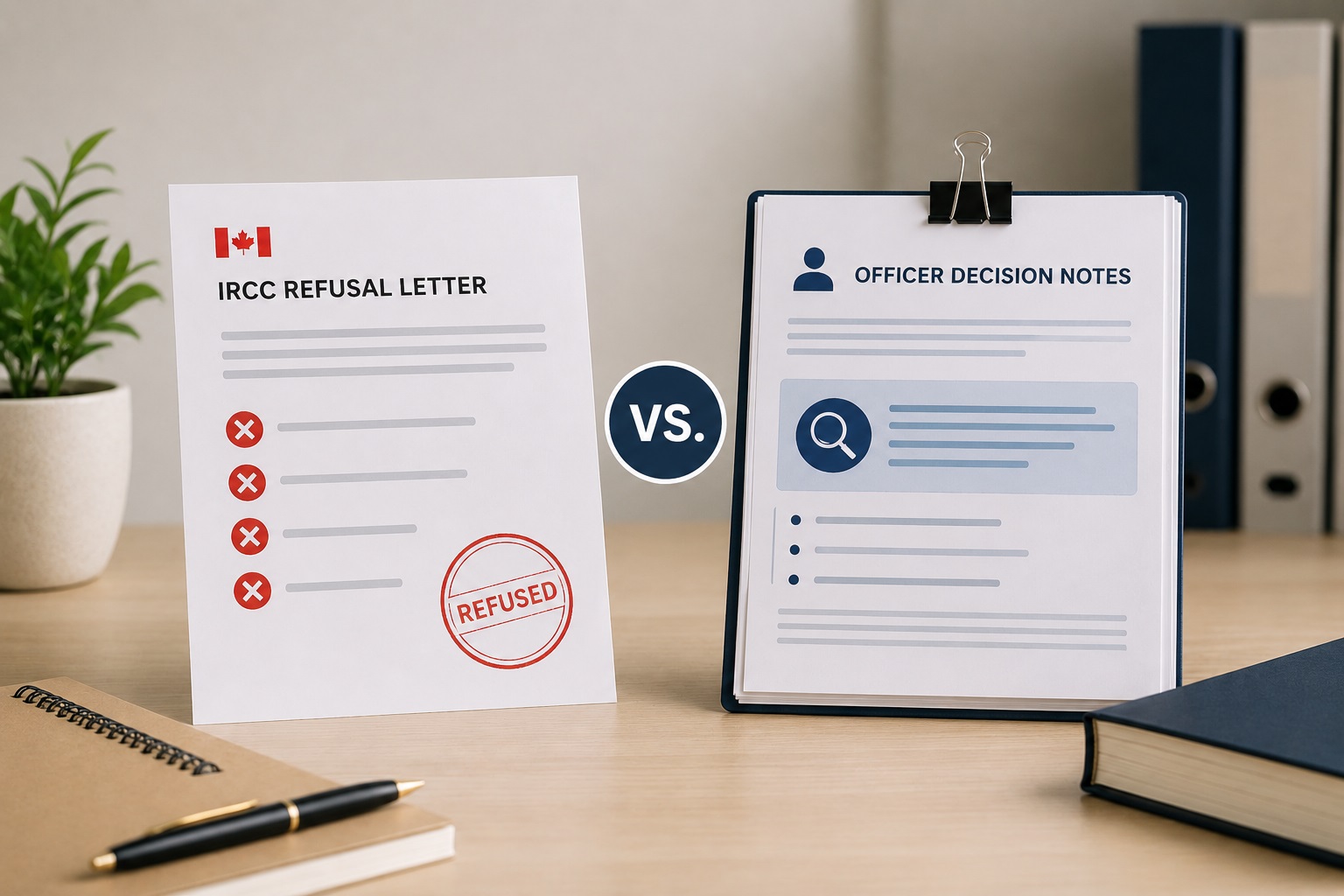
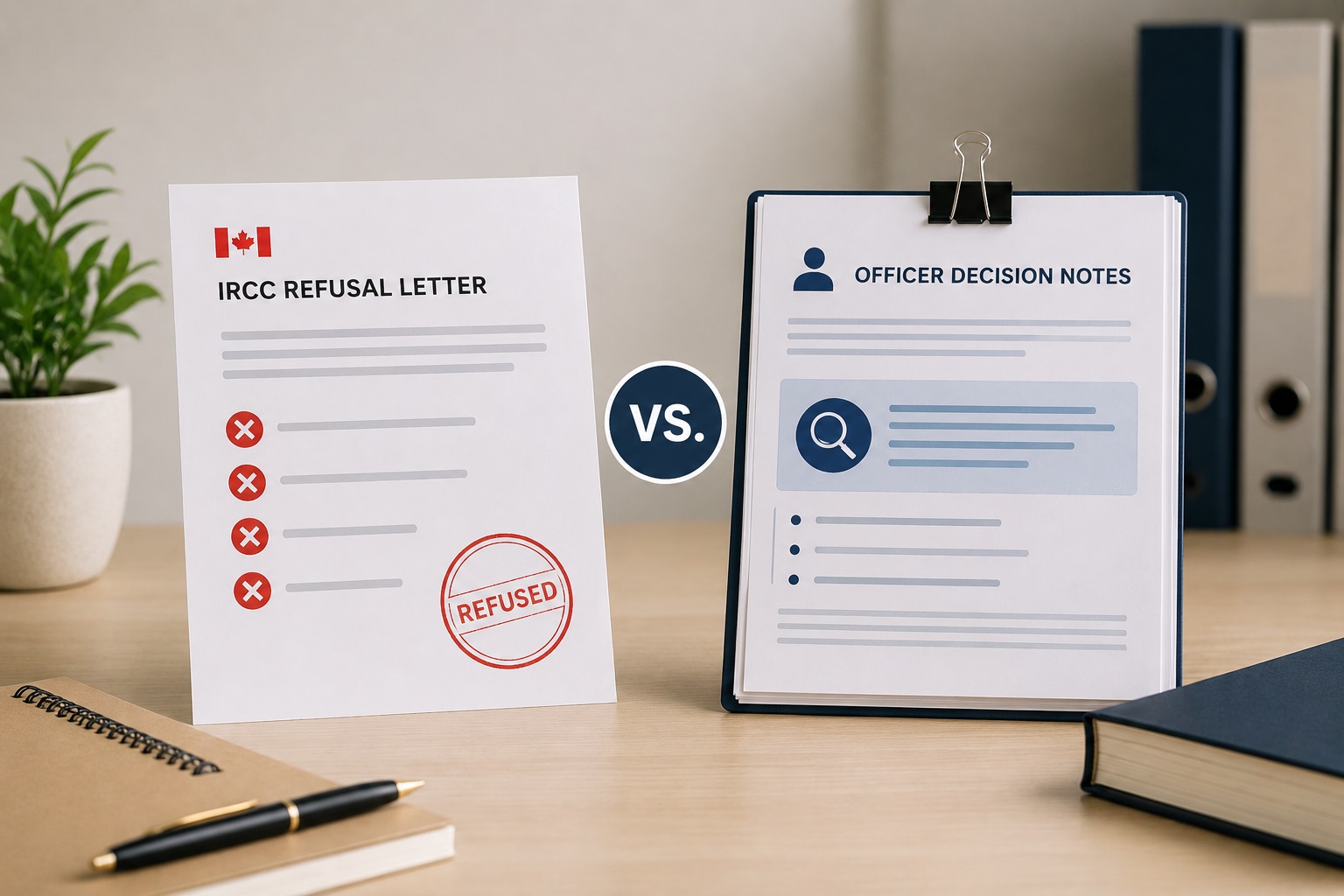
IRCC Refusal Letter v. Officer Decision Notes
For many temporary resident applications, IRCC has begun providing additional information on refusal decisions in the form of Officer Decision Notes (ODNs), which offer insight into the officer’s reasoning beyond the Canada refusal letter.
It makes a difference.
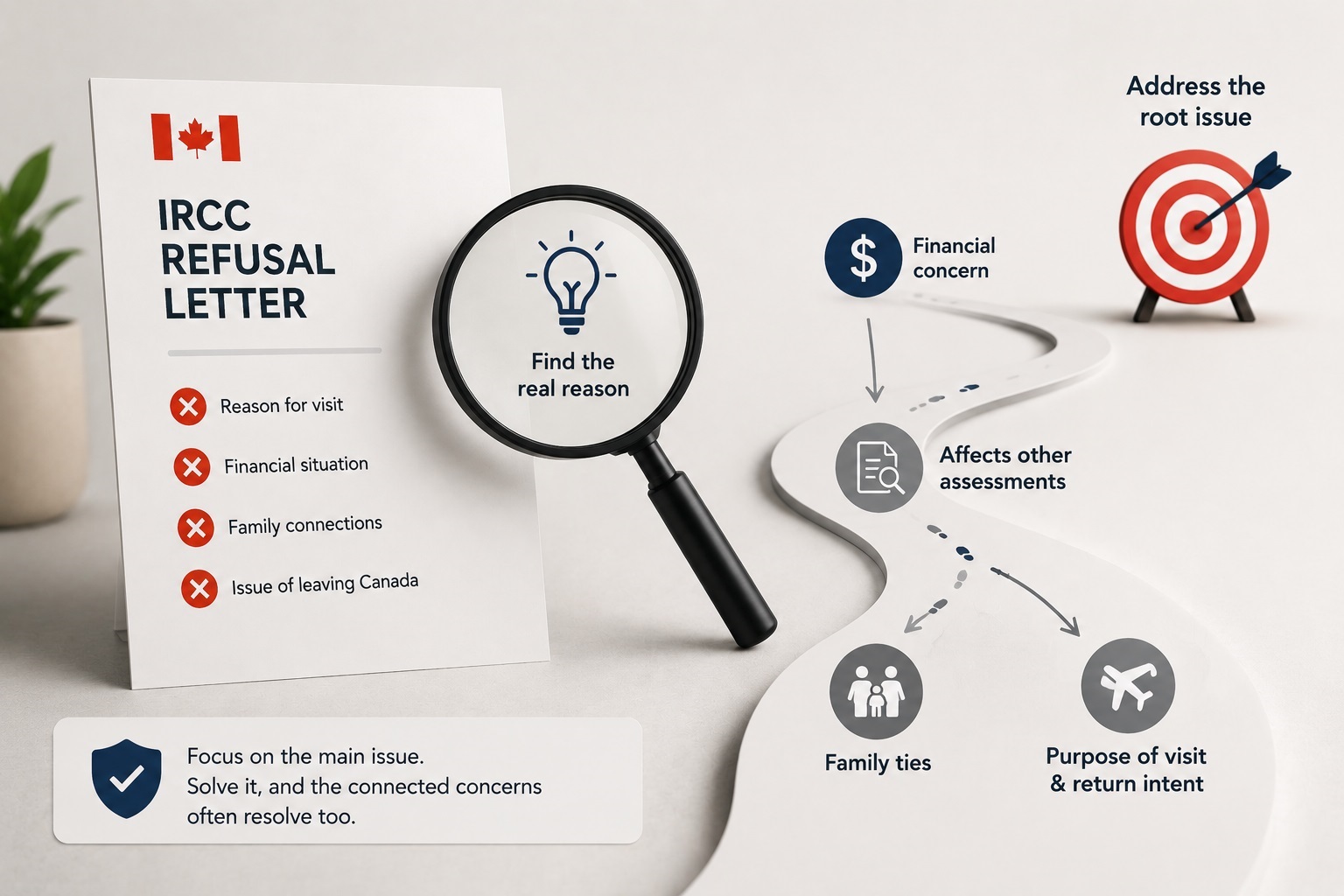
A refusal letter may highlight multiple general issues, including the following:
· Reason for visit
· Financial situation
· Family connections
· Issue of leaving Canada
However, it may be the case that the key issue identified in the officer’s decision was in fact much more specific – for instance, an unknown source of funds or a study program the officer believed was inconsistent with the applicant’s education and work experience.
Knowing the officer's reasoning can significantly influence your post-refusal plan, helping you feel more empowered and clearer about your options.
Applicants who wish to proceed may also seek additional documents from IRCC, including GCMS notes, using relevant access-to-information provisions.
However, applicants need to be aware that waiting for additional documents, such as GCMS notes or Officer Decision Notes, could jeopardize meeting relevant deadlines, as those deadlines are relatively short in some cases. Acting promptly can be crucial to preserving your legal options.
Why Are Several Reasons Listed in a Canada Refusal Letter?
Just because an IRCC refusal letter cites several reasons doesn’t mean there were several entirely unrelated issues in the application.
One reason might be independent, while others might be connected to the primary concern.
For example, an officer can be dissatisfied with a candidate's financial situation when considering their visitor visa application. At the same time, an officer might consider that dissatisfaction when evaluating the candidate's purpose of travel and whether they would return to their home country after a certain period in Canada.
In another case involving a study permit application, whether the course of study makes sense in relation to the applicant’s background can also affect the officer's evaluation of the applicant's purpose for travelling to Canada.
For this reason, a proper review should ask:
Which ground actually formed the basis for the refusal?
This can be more helpful than analyzing each statement in the refusal letter separately.
How to Categorize Grounds in a Canada Refusal Letter
In cases where an IRCC refusal letter provides grounds for refusal, it can be effective to separate the grounds into those that are primary grounds and those that are secondary grounds.
1. First Look for Eligibility/Admissibility Issues
Certain issues will automatically result in rejection of the application.
These include:
• non-compliance with mandatory requirements of a particular program;
• absence of documentation required;
• insufficient proof of financial capability;
• misrepresentation;
• inadmissibility for criminal or medical reasons;
• inadmissibility for security reasons; or
• non-compliance with specific eligibility requirements.
Address these issues first, as improvements to other issues in the application may not resolve them.
2. Identify Which Issues Are Related to the Principal Issue
Some other grounds for refusal may also relate to the principal issue raised by the officer.
For instance:
Unexplained financial transactions → Doubts about the availability of funds → Concerns about the veracity of the trip → Concerns about whether the applicant will leave Canada
These grounds could also be related to one another and not completely separate from each other.
Understanding this relationship is crucial for identifying what needs to be corrected in the reapplication and the potential vulnerability of the officer’s rationale.
3. Examine Whether the Officer Had Already Been Presented With the Evidence That Answered Their Concerns
The third question is crucial:
Was there evidence presented that addressed the officer’s concern?
There is a significant distinction between:
• evidence that was never provided; and
• evidence that was provided but either was missed, misunderstood, or improperly interpreted.
The former could make the reapplication more powerful, while the latter could be problematic for reconsideration or judicial review.
What Do You Do After Your IRCC Rejection Letter?
It’s not always clear how to respond after your Canadian immigration application was rejected, especially if the Canada refusal letter specifies deadlines or procedural steps. This typically depends on the reason for the rejection, the original evidence presented, new evidence available, the time limits, and the immigration category in question.
There are three primary options: reconsideration, reapplication, and judicial review.
Option 1: Requesting IRCC to Reconsider the Rejection
Reconsideration is essentially asking IRCC to re-examine their decision.
In some cases, it might be reasonable to seek reconsideration if the decision-maker:
• has made a clear mistake of fact;
• has misunderstood crucial information;
• seems to have missed important evidence previously submitted; or
• has made a mistake that could be fixed without a whole new application.
Now, you might ask how to write a reconsideration letter for a Canada visa refusal? a request for reconsideration is not an appeal, and IRCC is under no obligation to consider it.
Accordingly, a well-founded request for reconsideration should identify the alleged mistake and justify the request.
Most importantly, requesting reconsideration does not automatically pause or extend the deadline for taking other actions. Applicants who want to challenge the decision in court or on appeal should note the relevant deadline.
Option 2: Applying Again After an IRCC Rejection
Re-applying is probably the best course of action in a majority of cases—especially where the initial rejection was due to missing, poor, incomplete or ambiguous evidence.
However, submitting the same application again is never a good idea.
Re-applying Following Visitor Visa Refusal
If a visitor visa has been refused due to financial considerations, the re-application could require improved documentation regarding:
• Available financial resources;
• Employment and income;
• The source of major deposits;
• Cost and duration of the proposed trip;
• The sponsor of the trip; and
• Overall financial situation of the applicant.
Where the purpose of travel was questioned in the initial application, the new application must include detailed reasons for the applicant's travel, the duration of the visit, and how the proposed visit relates to the applicant's situation.
Re-applying Following Study Permit Refusal
Where the letter of refusal for a study permit highlights concerns about the proposed studies, finances, prospects for employment, prior education, or the intent of the applicant to leave Canada, the new application could include:
• Clarified study plan;
• The link between prior education, employment, and the program proposed;
• Better financial information;
• Explanation of career goals of the applicant; and
• Answers to the questions asked in the letter of refusal.
Hundreds of pages of documents are not necessary. It is essential to address the issue that caused the previous application's failure.
Option 3: Appeal or Challenge the Refusal of IRCC
Some immigration decisions can be formally appealed while others can be challenged in Federal Court.
The proper procedure will depend on the type of immigration decision.
Appeals Before the Immigration Appeal Division
Some immigration decisions, including refusals of family sponsorship applications, can be appealed to the Immigration Appeal Division (IAD).
IAD appeals are different from judicial review applications. In certain cases, depending on the type of appeal, you can include new evidence and raise other issues, in addition to whether the decision was unreasonable.
Legislation defines appeal rights and limits them in certain cases. Therefore, the ability to appeal must be determined on a case-by-case basis.

Judicial Review at the Federal Court
Some IRCC decisions cannot be appealed through the regular appeals process.
You can have refusals of visitor visas, study permits, work permits, and most permanent resident applications reviewed by filing an Application for Leave and Judicial Review with the Federal Court of Canada.
Judicial review is not a new immigration application, and the Federal Court will not replace one decision with another.
In some cases, the Federal Court might examine whether the decision was made reasonably and in accordance with due process.
If the case succeeds, the typical remedy is setting aside the refusal and returning the application for consideration.
Challenging a Canada Refusal Letter With Multiple Reasons
Where there are multiple reasons for a refusal, careful consideration is required.
In a situation where an officer refuses an application based on independent reasons, proving that one reason was made without proper consideration may not be sufficient when another independent reason still supports the decision.
In such circumstances, the law requires a determination on the following issues:
1. Whether the reasons are indeed independent;
2. Whether the identified errors impact the overall decision;
3. Whether there were significant facts overlooked or misconstrued;
4. Whether the record supports the findings of the officer; and
5. Whether there was any procedural issue.
At times, the reasons will be interconnected. If an error in one of the main reasons influences the assessment of the others, the error may affect the reasoning process.
This is one of the many reasons it is essential to review the decision and application record before initiating judicial review proceedings.

Reapply or Challenge the Refusal?
One of the most common questions after receiving a Canada visa refusal letter is:
Should I reapply or challenge the decision?
Neither option is automatically better.
Situation | Reapplication May Be Appropriate | Legal Challenge May Be Appropriate |
Important evidence was missing. | ✓ | |
Financial documentation can now be strengthened. | ✓ | |
Purpose of travel was poorly explained. | ✓ | |
Circumstances have materially changed. | ✓ | |
Important evidence already submitted appears to have been overlooked. | ✓ | |
Refusal appears based on a significant factual error. | ✓ | |
Officer's reasoning appears unreasonable. | ✓ | |
Procedural fairness may have been denied. | ✓ |
The application may also require different strategies depending on the legal requirements. The correct strategy depends on the situation.
Legal Deadlines Following an IRCC Refusal
The first thing to keep in mind after receiving a Canada refusal letter is that legal deadlines may begin immediately.
For an application for leave and judicial review related to a matter occurring in Canada under the Federal Courts Act, the standard deadline is 15 days.
Where the matter occurs outside of Canada, the standard deadline is 60 days.
Other legal procedures, including IAD appeals, will have their own deadlines.
Because whether the matter occurred and where it occurred involves a legal determination, do not assume there are months before a decision must be made.
GCMS notes ordered, or IRCC reconsideration, does not by itself automatically stop a Federal Court deadline.
Mistakes After Being Refused Entry to Canada
One of the most common mistakes is submitting another application before one knows what happened.
Some other mistakes are:
• relying only on the general language used in the refusal letter;
• submitting again an almost identical application;
• adding lots of unnecessary information to the application;
• treating secondary issues but not addressing the main issue;
• believing that reconsideration automatically extends the deadline for a case in court;
• depending on GCMS notes when a legal deadline expires; and
• believing that all refusals by IRCC have a regular appeal process.
The aim should not just be to submit additional information. The goal should be to find out what went wrong and how to fix it.
Frequently Asked Questions About Canada Refusal Letters
Can I appeal the Canada refusal letter?
Depending on the nature of the decision, certain immigration decisions may be appealed to the Immigration Appeal Division. In contrast, many temporary residence and economic immigration refusals lack a traditional right of appeal and, in appropriate cases, may be judicially reviewed in the Federal Court of Canada.
Can I reapply immediately after a Canadian visa refusal?
No general rule across many immigration programs prevents an applicant from filing a new application after a refusal. Reapplication without addressing the issues which led to the previous refusal will likely result in another refusal.
Do I need GCMS notes in case of refusal?
GCMS notes are not always necessary. Sometimes the information in the Officer Decision Notes and the Canada refusal letter is sufficient. Nevertheless, GCMS notes may also provide additional information in the appropriate case. One should not wait for GCMS notes and miss a legal deadline.
Does a reconsideration request stop the Federal Court deadline?
The Federal Court deadline should not be assumed to stop because of such a request. If judicial review is under consideration, it needs to be considered separately.
Can the Federal Court grant me the visa?
In judicial review, the Federal Court does not focus on the content of the visa application. Judicial review usually addresses the legality, reasonableness, and procedural fairness of the decision-making process. If an applicant succeeds, the refusal would be set aside and redetermined by the competent authority.
What if the Canada refusal letter states multiple reasons?
Consider every reason stated in the Canada refusal letter alongside the officer's notes and the submitted documents. Some findings may stand alone, but others may depend on a single issue.
Your Canadian Immigration Application Was Denied. Now What Do You Do?
A denial from IRCC does not necessarily signal the end of your Canadian immigration issue.
The real questions are what led to the refusal and how to fix it with new evidence, reconsideration, an immigration appeal, or judicial review in the Federal Court.
The attorneys at Visa Appeal analyze Canadian immigration denials to determine the officer's crucial findings and potential legal remedies.
Since time limitations on appeals and judicial reviews are often very strict, you must act immediately after receiving your denial notice.