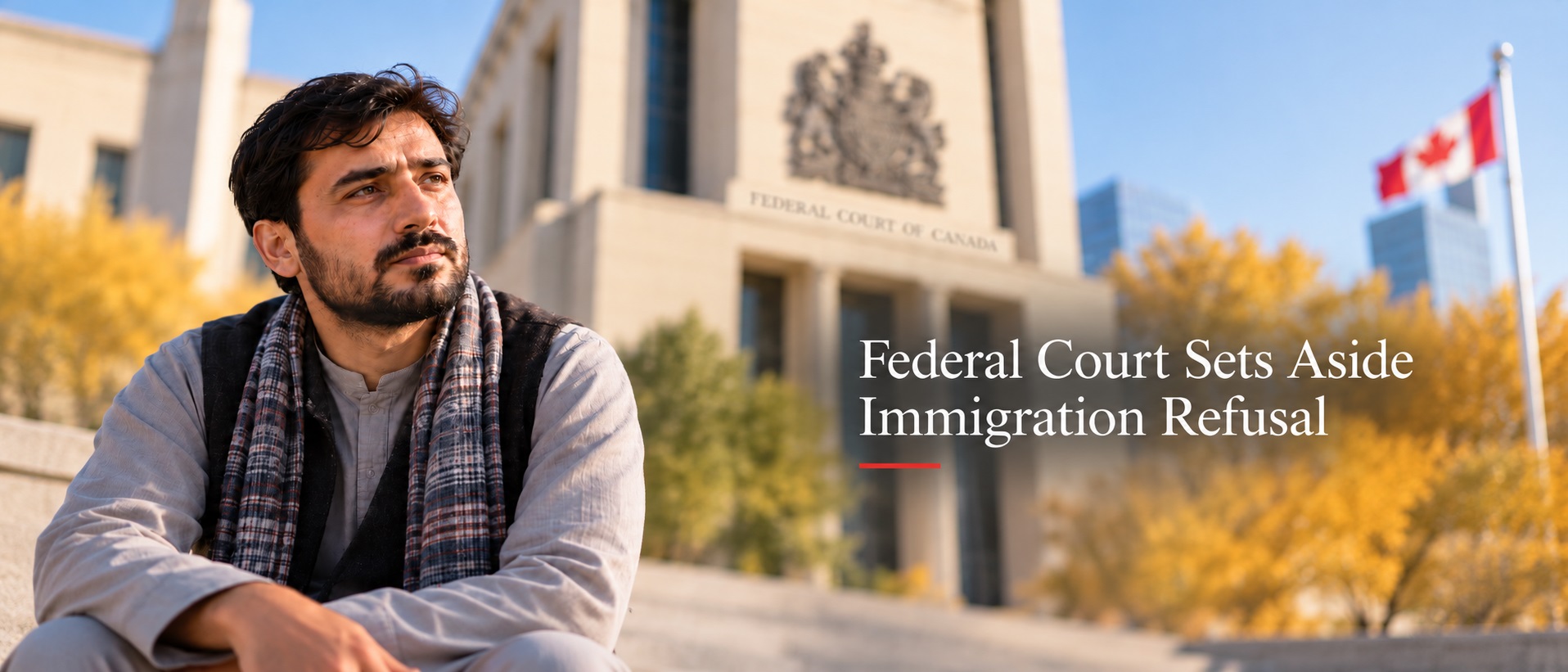
Past Persecution Is Not Enough: Federal Court Confirms Current Risk Requirement in PRRA Applications
In the recent case of Sanmugarasa v. Canada (Citizenship and Immigration), 2026 FC 1023, decided on July 30, 2026, the Federal Court of Canada reiterated an essential aspect of Pre-Removal Risk Assessment (PRRA) applications: previous persecution does not necessarily mean future risk.
The court denied the application after concluding that it was reasonable for the immigration officer to determine that the applicant could not show a current risk of danger upon his return to Sri Lanka.
This decision will be helpful for those making a PRRA application or challenging a PRRA decision.
Case Background
The applicant, a national of Sri Lanka, arrived in Canada in February 2024 and applied for refugee protection. Since he was deemed inadmissible for security reasons because of his supposed affiliation with the LTTE, he could no longer make a refugee claim but was only entitled to an application under s—97 of the IRPA.
In applying for PRRA, the applicant stated that:
He was never a member of the LTTE.
He admitted being involved with LTTE after getting bad legal advice.
He was arrested and tortured for being a Tamil.
He was once more threatened after taking part in anti-government demonstrations in 2022.
He is likely to be tortured and persecuted if he returns to Sri Lanka.
PRRA officer refused the application since there was no evidence showing that the Sri Lankan government still has any interest in the applicant.
Applicant's Submissions to the Federal Court
The applicant gave various reasons for challenging the PRRA determination.
The applicant claimed that the officer:
dismissed supporting letters for what they did not say;
misunderstood the risk assessment of the applicant as a member of the LTTE;
reviewed the country conditions selectively; and
expected corroboration despite sworn testimony.
Why the Federal Court Rejected the Application
The Federal Court did not find any of these grounds to be reasonable. In the case at hand, it was Judge Pallotta who determined that the PRRA officer had considered both personal evidence and country conditions, concluding that the applicant had not proven any risk of being subjected to torture, death, or cruel and unusual treatment.

Important Legal Considerations Drawn From the Case
1. Previous Persecution Does Not Necessarily Mean Future Risk
Undoubtedly, the most important takeaway from this case is that PRRA applications are meant to address current dangers and future risks, not only past experiences, to reassure legal professionals and applicants that current circumstances matter most.
While the applicant claimed that he was subjected to harsh persecution in the past, the Court sided with the officer’s opinion that there was no proof of current interest of Sri Lankan authorities in him.
The Court emphasized that previous persecutions do not necessarily determine future risks under section 97 of the IRPA.
2. The Applicant Has to Prove a Personalized and Present Risk
The court reiterated that general country information is not enough. Even if there are ongoing discrimination or human rights violations in Sri Lanka, applicants must demonstrate that they face a specific, current risk personally, not just rely on general country conditions.
According to the PRRA officer, the applicant is not a member of the profile group being persecuted by the Sri Lankan authorities, as:
the applicant is not an LTTE member,
the applicant has no criminal record,
there was no objective evidence of any present government interest in him.
3. Supporting Letters Must Speak to the Relevant Issue
The supporting material, including letters from relatives and a physician, should clearly demonstrate the applicant's present situation to help applicants feel their efforts are meaningful and appreciated. The Court found that the officer had reached a reasonable conclusion that these documents did not prove the existence of risk, since these documents related mostly to past events and did not prove that Sri Lankan officials still wanted the individual.
This means that the officer did not disregard the evidence but rather that the evidence did not speak to the issue. According to the applicant, the officer had selectively cited the country situation, but the Court’s review of the entire context aims to ensure applicants and professionals feel the process is thorough and balanced. According to the applicant, the officer had selectively cited the country situation.
4. The Court rejected this claim.
According to Justice Pallotta, the officer took into account:
discrimination in Tamil areas;
detention under anti-terrorism laws;
surveillance of some LTTE members;
changes in the political situation in Sri Lanka.
Taking into account all of this evidence, the officer correctly concluded that individuals who were involved in the LTTE to a considerable extent were at higher risk than the applicant.
5. Insufficiency of Evidence without Requiring Corroboration
The other very important issue related to the judgment is corroboration. The applicant claimed that the officer had asked for more documents.
However, the Court dismissed this argument.
In fact, the officer took into account the evidence offered by the applicant and considered it insufficient to prove the existence of a personalized risk.

Reasons Why This Case Is Important
This ruling has reinforced some practical considerations highlighted by this case. PRRA applications will require more than proof that past events were traumatic.
Instead, there should be proof of:
interest on the part of the authorities in the applicant;
risk still exists in the present time;
that the conditions of the country in question allow for individualized risk assessment; and,
that the risk is specific to the applicant.
Without this proof of risk moving from the past into the present, a PRRA application could very well fail despite past persecution.
Key Practical Lessons for PRRA Claimants
Some key lessons from this case for those applying for a PRRA include:
Concentrate on proving your risk currently, as opposed to past persecution alone.
Where possible, give objective proof of government interest in you.
Your supporting letters should discuss your current situation, not just your history.
Use your personal evidence in conjunction with the current conditions of your home country report.
Explain how you remain an individual at risk despite the change in conditions of your home country.
Federal Court Decision
Sanmugarasa v. Canada (Citizenship and Immigration)
Citation: 2026 FC 1023
Court's Decision: Judicial Review Dismissed
In this case, the Federal Court held that the PRRA officer correctly found that there was no reasonable fear of a personalized and prospective risk under section 97 of the IRPA. Accordingly, it dismissed the application for judicial review of the decision refusing the PRRA application.

Frequently Asked Questions
Is it sufficient to have experienced torture before to be granted PRRA?
No. The experience of past persecution is an important component, but applicants should also prove a present, forward-looking risk of persecution if they return to their country.
What does a forward-looking risk mean?
A forward-looking risk is a personal risk that currently exists or is likely to happen after return, unlike past harms suffered by the applicant.
Is it possible to get protection based on the general country situation through PRRA?
Yes. But still, applicants need to prove a personal risk reflected in the report.