
Strategies for Avoiding Misrepresentation
The occurrence of misrepresentation in contractual obligations is evident where one of the contracting parties gives erroneous, misleading, or false information to another contracting party to convince them to sign an agreement.
Based on the nature of the circumstances surrounding the misrepresentation, the contract may be deemed null and void, allowing the aggrieved party the right to seek remedies like rescission of the contract and/or compensation for damages. There are many other important aspects regarding the issue of misrepresentation that need to be known.
Definition of Misrepresentation in a Contract
Misrepresentation is commonly defined as a misleading statement of facts which affects another person in making a contract. However, not all wrong statements would constitute misrepresentation legally. Some of the important elements of misrepresentation include:
· the statement in question;
· whether the statement was material in relation to the business transaction;
· whether the statement was relied upon;
· whether the statement affected the decision of entering the contract; and
· whether there was any resulting damage due to the reliance.
Misrepresentation Categories
Three broad classifications of misrepresentation in a contract exist.
Fraudulent Misrepresentation
Fraudulent misrepresentation can take place where an individual has made a knowingly false statement, or has stated something they do not believe is true, intending that the other party will act on it. The following are some examples of instances where such fraudulent misrepresentation may be found:
Misrepresentation by Negligence
Misrepresentation by negligence could be committed where inaccurate information is given without making reasonable efforts to confirm its accuracy. This does not necessarily mean that there was intent to deceive.
Innocent Misrepresentation
An innocent misrepresentation takes place where a person gives information which they believe to be true, but which turns out to be untrue. It is possible that there was no intention to deceive; nevertheless, the misrepresentation could have an effect on the bargain, as it influenced one of the parties in the contract.
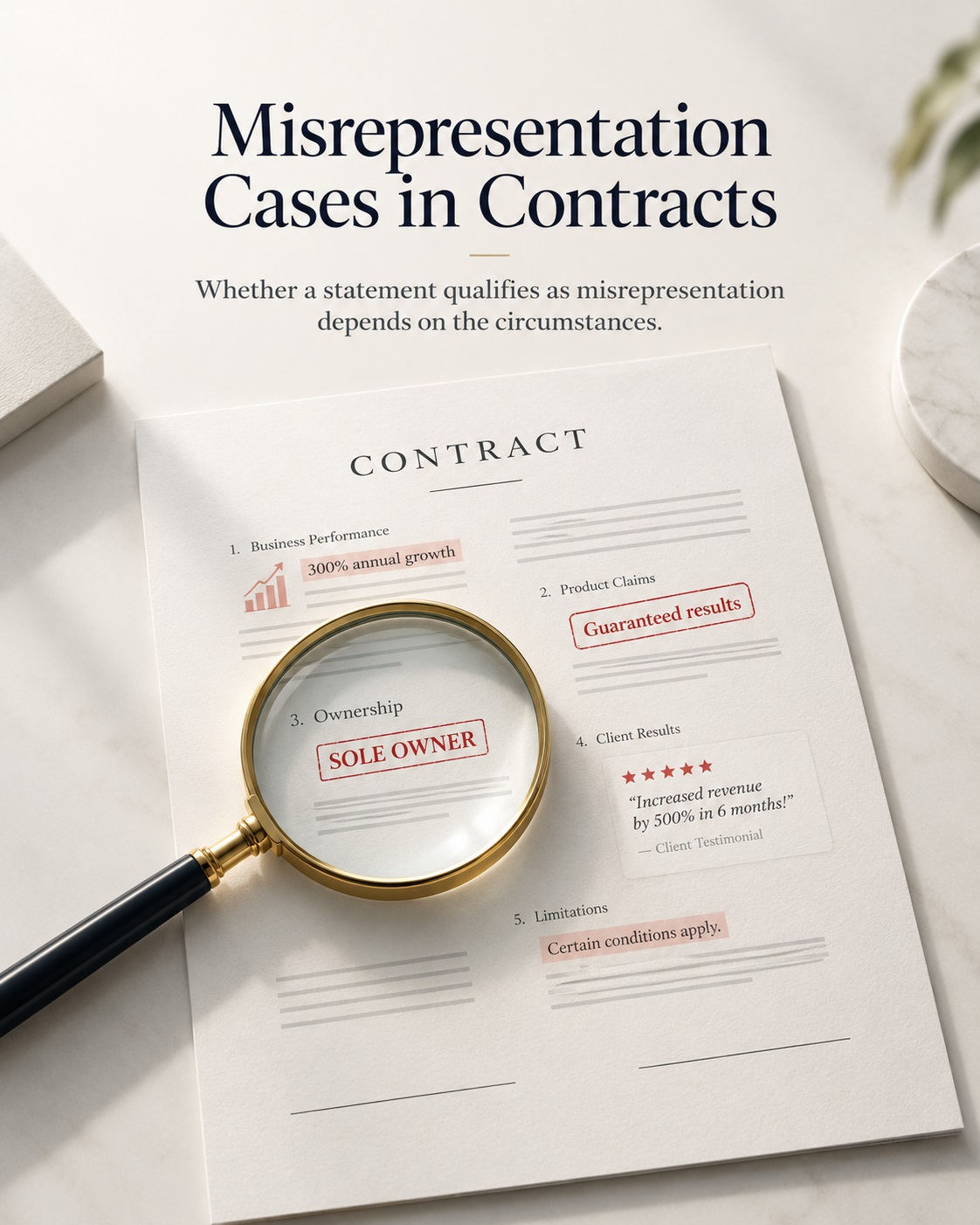
Misrepresentation Cases in Contracts
Misrepresentation may occur in various business dealings. This can take the form of:
· Exaggerated financial performance by a company;
· Untrue claims regarding products or services offered;
· Promises of unrealistic or unattainable performance;
· Provision of false information on ownership of properties or assets;
· Claims of outstanding client results being average outcomes; or
· Inadequate provision of details about certain limitations.
It will depend on the circumstances whether or not a particular statement qualifies as misrepresentation.
Misrepresentations During Negotiations
Words said prior to the signing of a contract can be very significant. These include sales presentations, proposals, emails, advertising, and negotiations containing representations which affect the customer’s decision.
For this reason, businesses need to make sure that their employees have an understanding of what they can truly offer. Promises about performance, savings, outcomes, delivery dates, or ROI should all be founded upon accurate data and not assumptions and exaggerations. Additionally, businesses need to inform customers about their limitations.
What Should Be Done in Case of Misrepresentation?
If you believe that you have signed a contract under false information, gathering evidence is critical. Documents which could be helpful might be:
· a copy of the contract;
· email and message exchanges;
· proposals;
· ads;
· financial data;
· presentations;
· reports; and
· previous drafts of the agreement.
It might also be useful to make a list, specifying what had been said, by whom, at what time, and how it affected your decision. Depending on the situation, notice could be officially given to the counterparty.
Legal Solutions to Misrepresentation
The solutions depend on the nature of misrepresentation, the contract, and the governing law.
Rescission
The possibility of rescission may enable one to void the contract and, to the extent that it can, return the parties to their pre-contractual state. Nevertheless, rescission cannot always be applied.
Damages
A party can also obtain financial compensation as a result of the losses suffered due to the misrepresentation. The kind and extent of such damage will depend on the case and law in question.
Prevention of Misrepresentation
There are some ways that businesses can use to minimise chances of misrepresentation.

Check Important Information
Financial, technical, and business information must be validated prior to its communication to another party.
Contract Language Should Be Unambiguous
Material representations, warranties, obligations, limitations, and payments should be made unambiguously clear.
Avoid Unrealistic Promises
Companies need to be able to tell the difference between probable results and likely results.
Explain Limitations
Consumers must not only know what a product or service does, but also the limitations and conditions under which the service operates.
Important Representations Should be Recorded
Recording important representations may help prevent disputes over what was agreed upon during negotiations.
When Should You Talk to a Contracts Lawyer?
It might be wise to seek legal counsel if:
· money damages will be sought;
· fraud is suspected;
· one side seeks to terminate the contract;
· there is an issue regarding misrepresentation; or
· litigation is contemplated.
A lawyer will be able to evaluate the contract, the communications, and the facts to decide what your options are.
Commonly Asked Questions
What are the different forms of misrepresentations?
There are basically three forms of misrepresentation, namely: fraudulent, negligent and innocent.
Must there be an intention to misrepresent?
No, fraudulent misrepresentation requires an intention, but negligent and innocent misrepresentation need not be intentional.
Is a contract rescinded due to the misrepresentation?
Maybe. There might be instances when rescission is possible, but it will depend on the specific details.
How do firms avoid making misrepresentations?
Firms may prevent this from occurring through such means as validating their claims, informing of restrictions, being realistic, documenting their representations, and using contracts.
Conclusion
Misrepresentation may have implications regarding how a contract was made. It may be due to fraud, carelessness or innocent mistakes, but the repercussions would largely depend on the situation. Good communication, correct information and proper documentation could go a long way in avoiding cases of misrepresentation before they happen. The article is just a source of general information and cannot be taken as legal advice.